
 Türkçe
 Deutsch
 Français
Urological conditions affect vital organs including the kidneys, bladder, urinary tract and male reproductive system — and can significantly reduce quality of life. By 2026, urology treatments have been transformed by laser technology, robotic surgery and minimally invasive endoscopic techniques, delivering less pain, faster recovery and higher success rates. In this comprehensive guide, we cover everything from kidney stones and prostate conditions to urinary incontinence and bladder cancer. For more information, visit our EFC Clinic Urology Treatments unit.
What Is Urology?
Urology is the medical speciality that diagnoses and treats conditions affecting the urinary tract — kidneys, ureters, bladder and urethra — as well as the male reproductive organs including the prostate, testes and penis. It serves both male and female patients across a wide spectrum from medical management to minimally invasive surgery, laser procedures and robotic operations.
Early specialist evaluation of urological symptoms significantly improves treatment outcomes and helps prevent serious complications. EFC Clinic's specialist urologists conduct a comprehensive individual assessment and develop the most appropriate, minimally invasive treatment plan for each patient.
Kidney Stone Treatment
What Are Kidney Stones?
Kidney stones are hard deposits of minerals and salts that form inside the kidneys or urinary tract when urine becomes too concentrated. Symptoms include severe flank pain, blood in the urine, nausea and difficulty urinating. Treatment depends on the size and location of the stone.
ESWL (Extracorporeal Shock Wave Lithotripsy)
ESWL is a non-surgical treatment that uses externally applied shock waves to break kidney stones into small fragments that can pass naturally through urine. No anaesthesia or only mild sedation is needed. The procedure takes 45–60 minutes and patients go home the same day. It is ideal for stones between 4 and 20 mm in size.
URS (Ureteroscopy) and Laser Stone Fragmentation
In ureteroscopy, a thin camera instrument is passed through the urethra and bladder to reach the stone, which is then vaporised using a holmium laser. No incision is required and recovery is very fast. This is typically a day-case procedure.
PCNL (Percutaneous Nephrolithotomy)
For large or complex kidney stones, PCNL involves making a small puncture in the back to insert specialised instruments that break up and remove the stone. General anaesthesia is required and a 2–3 night hospital stay is expected. It is the most effective method for stones larger than 2 cm.
Prostate Conditions and Treatment
Benign Prostatic Hyperplasia (BPH)
BPH is the non-cancerous enlargement of the prostate gland, particularly common in men over 50 years of age. It causes a weak urinary stream, frequent and urgent urination, nocturia and incomplete bladder emptying. When medical options prove insufficient, surgery is indicated.
TURP (Transurethral Resection of the Prostate)
The gold-standard surgical treatment for BPH, TURP involves removing obstructing prostate tissue using an instrument passed through the urethra — no skin incision is required. Performed under general or spinal anaesthesia, it typically requires a 1–2 night hospital stay.
Laser Prostatectomy (HoLEP / GreenLight)
Laser-based prostate surgery — particularly HoLEP (Holmium Laser Enucleation of the Prostate) and GreenLight laser — offers significant advantages over TURP including less bleeding, faster recovery and shorter hospital stay. It is effective even for very large prostates. Learn more about laser prostate treatments on our dedicated page.
Prostate Cancer
Prostate cancer is one of the most common cancers in men. Early-stage prostate cancer can be treated with active surveillance, radiotherapy or radical prostatectomy (surgical removal of the prostate). Laparoscopic and robotic surgical approaches offer significantly fewer complications and faster recovery compared to open surgery. Our specialist urologists develop the most appropriate plan based on individual staging.
Urinary Tract Conditions
Urinary Incontinence
Urinary incontinence can manifest as leakage during coughing, sneezing or exercise (stress incontinence), or as a sudden, overwhelming urge to urinate (urge incontinence). Treatment options range from pelvic floor exercises and medication to minimally invasive procedures such as mid-urethral slings and bladder Botox injections, and surgical correction when needed.
Recurrent Urinary Tract Infections (UTIs)
Recurrent UTIs may signal an underlying anatomical abnormality, bladder dysfunction or immune system issue. In chronic cases, cystoscopy — direct camera examination of the bladder — is performed to identify the root cause and guide targeted treatment.
Bladder Cancer
The most common symptom of bladder cancer is blood in the urine (haematuria). Early-stage bladder cancer can be treated with TURBT (transurethral resection of bladder tumour) performed under cystoscopic guidance. Advanced cases may require chemotherapy, radiotherapy or cystectomy (bladder removal).
Laser and Endoscopic Urology
Laser and endoscopic techniques have become central to urological practice in 2026, making many procedures truly minimally invasive:
- Holmium laser: The gold standard for kidney stone fragmentation and prostate enucleation.
- Thulium fibre laser: More precise cutting with less thermal damage — the newest technology of 2026.
- GreenLight laser: Fast and safe tissue vaporisation for BPH treatment.
- Flexible ureteroscopy: Flexible camera systems that can reach all parts of the kidney.
- Laparoscopic and robotic surgery: Minimally invasive approaches for kidney, prostate and bladder operations.
EFC Clinic's patient services provide full pre- and post-operative support for all laser urology procedures.
Why Choose Turkey and EFC Clinic?
- Experienced urologists: Internationally trained surgeons with high-volume caseloads.
- Advanced technology: Holmium and thulium laser systems, robotic surgical platforms.
- Cost advantage: The same quality treatment at 40–60% lower cost than Western Europe.
- Fast access: Short waiting times from consultation to surgery.
- Comprehensive packages: Transfer, accommodation and post-operative follow-up included.
At EFC Clinic, our urology treatments unit delivers care to international standards. Contact us to begin your personal assessment. You can also explore our full range of medical treatments.
Frequently Asked Questions
Can kidney stones pass on their own?
Stones smaller than 4 mm often pass spontaneously with high fluid intake. Larger stones typically require medical intervention.
Is laser stone fragmentation painful?
Ureteroscopy and laser stone fragmentation are performed under general or spinal anaesthesia, so no pain is felt during the procedure. Mild burning on urination may occur for a few days afterwards.
Is prostate enlargement inevitable?
Prostate enlargement is a physiological process that occurs with age in men, but not every enlargement causes symptoms. Regular check-ups and early intervention preserve quality of life.
How does TURP affect sexual function?
TURP may result in retrograde ejaculation (semen entering the bladder rather than being expelled). This does not affect sexual pleasure but patients are informed beforehand.
Do urology procedures require a long hospital stay?
Many modern urological procedures are completed as day-case or 1–2 night stays. Robotic and laparoscopic methods have significantly shortened hospital admission times.
Is urology treatment in Turkey safe?
Treatment at accredited clinics by experienced urologists is safe and meets international standards. EFC Clinic operates in full compliance with current medical protocols.
Ready to address your urological concerns? Contact EFC Clinic for a free consultation, or explore our urology treatments unit for detailed information.
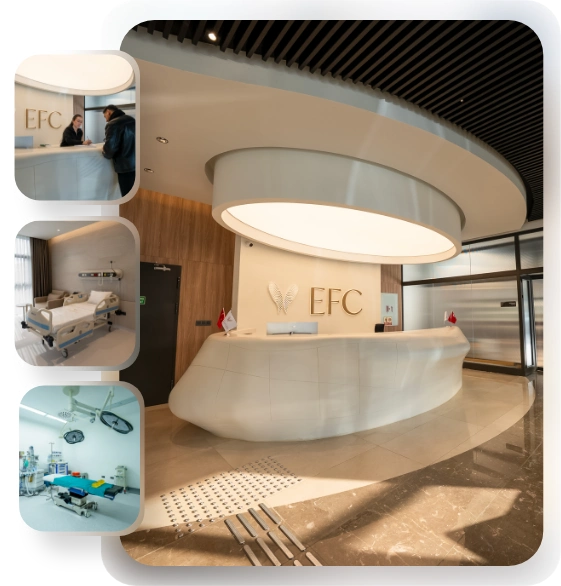
Comprehensive Care: From the First Examination to the Follow-Up Process.
EFC CLINIC is a center of excellence specializing in the most rigorous fields of surgical medicine—from aesthetic surgery to interventional treatments—where every step is carried out with meticulous care. Medical excellence, aesthetic precision, and an uncompromising ethical stance meet on the same line. Our subspecialty-trained specialists aim to achieve natural and reliable results by providing evidence-based care with modern imaging, standardized protocols, and safety systems. From consultation to recovery, your care is coordinated end-to-end with clear communication, transparent planning, and genuine respect for your health.