
 Türkçe
 Deutsch
 Français
Deep Plane Facelift is a structural surgical procedure that releases the deep muscle, fat, and connective tissue layers of the face that shift downward due to gravity during the aging process and re-fixates them as a whole back to their original positions. Unlike superficial methods that place tension only on the skin, this technique targets the sagging anatomical support structures directly and fundamentally repairs deformities in the midface, cheeks, and jawline. With this approach, in which the skin settles naturally—not tightly—over the new structure, it offers the most permanent and aesthetically pleasing results in facial rejuvenation surgery, avoiding a “mask” appearance and preserving facial expressions.
EFC CLINIC
Comprehensive Care: From Initial Consultation to Follow-Up.
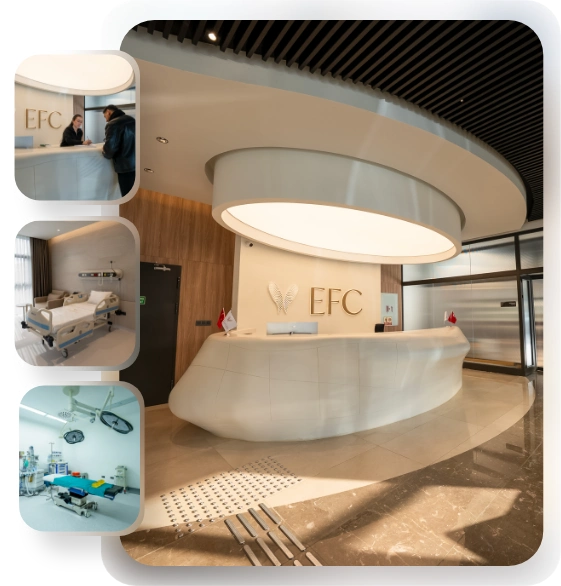
EFC CLINIC is a center of excellence specializing in the most meticulous fields of surgical medicine, from aesthetic surgery to interventional treatments—where every step progresses with refined attention. Medical excellence, aesthetic precision, and uncompromising ethical standards converge on the same path. Our subspecialty-trained experts aim to achieve natural and reliable results by delivering evidence-based care supported by modern imaging, standardized protocols, and safety systems. From consultation to recovery, your care is coordinated end-to-end with clear communication, transparent planning, and genuine respect for your health.
How Does Deep Plane Facelift Surgery Differ from Classical Methods?
The most common confusion we encounter in consultations with our patients is the belief that all facelift surgeries are the same. However, between classical methods and Deep Plane Facelift, there is as big a difference as painting only the exterior of a house versus reinforcing the columns in its foundation. Classical facelift techniques generally separate and tighten the skin over the muscular fascia called the SMAS. While this provides tightness in the short term, it creates a significant load on the skin because the heavy tissues underneath are still sagging.
In the Deep Plane technique, the surgeon enters beneath the SMAS layer, that is, into the deep fascial plane where the facial muscles and nerves are located. The goal here is not to separate the skin from the underlying muscle-fat tissue. On the contrary, these layers are released as a “composite” unit, meaning as a block without being separated at all. In this way, the vascular nourishment of the skin is not disrupted, and the skin is naturally lifted together with the underlying tissues. The skin is only a cover; the supporting strength is in the deep tissues. This approach prevents the undesired “artificial” or “shiny” skin appearance after surgery.
Why Must “Retaining Ligaments” Be Released During a Deep Plane Facelift?
There are strong ligaments that connect our face to the skull and cheekbones and enable the tissues to resist gravity. We call these “ligaments.” While these ligaments are tight when we are young, they loosen as we age but still continue to hold the tissues at certain points. As facial tissues sag downward, the points held by these ligaments remain sunken, creating a wavy, irregular appearance in the face. This is one of the reasons for jowling along the jawline and deep folds around the mouth corners.
The importance of these ligaments is this: if you do not cut and release them, no matter how much you pull the face, the tissue gets stuck at a point and will not move upward. In classical methods, these ligaments are generally not addressed. The most critical stage of Deep Plane Facelift surgery is the surgical release of these retaining ligaments with precision. Once freed from their anchors, the facial tissues can move freely. After this release is achieved, the sagging cheek and neck tissues can be repositioned upward and backward along a natural vector to where they should be, without any forced tension.
Contact us now to get detailed information about our treatments and procedures and to schedule an appointment!
What Kind of Change Does This Procedure Create in the Midface Area and Cheeks?
Signs of aging appear not only in the jawline but most prominently in the middle part of the face, namely the cheeks and under-eye area. The plump, firm appearance in the cheeks gradually shifts downward and accumulates along the sides of the nose. This makes the face look tired, sad, and older than it actually is. Classical facelift surgeries generally tighten the sides of the face, but their effect on the midline is limited.
Deep Plane Facelift has a unique ability to lift the midface region vertically. The cheek fat pads are returned to where they belong, back over the cheekbone, thanks to the released ligaments. This restores the “heart shape” that is a symbol of youth to the face. With the volumization of the cheeks, the under-eye hollows (tear trough) are also indirectly filled, resulting in a more refreshed look. In addition, the nasolabial folds running from the sides of the nose to the corners of the mouth are naturally softened without creating a tight appearance.
Why Do Deep Plane Facelift Results Look More Natural?
In aesthetic surgery, “success” is when it is not obvious that a procedure was done. No one wants a mouth that looks stretched as if walking against the wind or earlobes that have lost their shape. The greatest advantage of Deep Plane Facelift is its mechanism that guarantees naturalness. In this technique, tension is not placed on the skin. All lifting and suspension is performed on the robust muscle and fascia layer beneath the skin.
When the deep tissues are lifted and fixed, the overlying skin becomes looser. The surgeon gently lays this excess skin down without creating any tension and removes the surplus. Because the skin is not pulled, facial expressions are not distorted, the smile does not change, and the face does not become frozen. After surgery, the patient looks not like “someone else,” but like their own self from 10–15 years earlier. With this technique, the risk of a “pulled” look is almost nonexistent because what is being pulled is not the skin.
Who Are Ideal Candidates for a Deep Plane Facelift?
This procedure is suitable for individuals who have begun to show structural signs of facial aging, regardless of biological age. Although it is generally preferred starting in the 40s, it can be performed earlier or later depending on genetic factors. Typical signs seen in ideal candidates are as follows:
- Pronounced jawline sagging
- Deep nasolabial folds
- Loss of cheek volume
- Laxity in the neck area
- Marionette lines
- Formation of a double chin
- Midface hollowing
People who have these signs and still have some degree of skin elasticity make up the group that benefits most from this surgery. In addition, it is the most effective corrective method for patients who have previously had a superficial facelift but were not satisfied with the result.
Contact us now to get detailed information about our treatments and procedures and to schedule an appointment!
What Should Be Expected Regarding the Recovery Process, Bruising, and Scars?
Contrary to popular belief, the recovery process of deeper surgery such as Deep Plane Facelift can be more comfortable than superficial surgeries. The main reason for this is that the surgical plane is avascular. Since tissues are separated along natural planes of cleavage (avascular planes), bleeding is minimal. Less bleeding means less postoperative bruising and swelling.
Some conditions that our patients should pay attention to during the recovery process are as follows:
- Mild edema
- Temporary numbness
- Tightness around the ear
- Firmness in the neck area
These symptoms are temporary and generally subside to a level where one can return to social life within 10–14 days. Suture scars are hidden inside the ear and along the hairline border. Because the skin is not under tension, wound healing is of excellent quality and the scars become almost invisible over time.
What Are the Safety and Risks of Deep Plane Facelift Surgery?
Every surgical intervention carries certain risks, but the Deep Plane technique is extremely safe in experienced hands. The most concerning issue is the facial nerves, because this surgery is performed in the layer where the facial nerves are located. However, with the right technique, this becomes an advantage. The surgeon proceeds by seeing and protecting the nerves. It is not a “blind” procedure.
The factors that increase safety are as follows:
- Anatomical mastery
- Blunt dissection technique
- Nerve monitoring
- Experienced surgeon
Instead of sharp blades, special blunt instruments that do not damage the tissue are used while separating the tissues. In this way, the risk of nerve injury is minimized. General risks such as infection and bleeding are quite low when sterilization rules and preoperative preparations (such as blood pressure control and discontinuation of blood thinners) are followed.
Blog Posts

Most Preferred Countries for Hair Transplantation
Among the most preferred countries for hair transplantation are Turkey, India, South Korea, and Poland. [...]
Read More
21
Jan
Jan

Hair Transplant Prices
Hair transplant prices vary depending on the technique to be used, the number of grafts, [...]
Read More
21
Jan
Jan
Most Preferred Countries for Plastic Surgery
Among the most preferred countries for plastic surgery, Turkey, South Korea, the United States, and [...]
Read More
21
Jan
Jan
Plastic Surgery Prices
Plastic surgery prices vary depending on the type of procedure, geographical location, the surgeon’s experience, [...]
Read More
21
Jan
Jan

Physical Therapy Prices
Physical therapy prices vary depending on the number of sessions to be applied, the treatment [...]
Read More
21
Jan
Jan

Dental Treatment Prices
Dental treatment prices vary depending on the type of procedure to be performed, the quality [...]
Read More
21
Jan
Jan
Most Preferred Countries for Dental Treatments
Among the most preferred countries for dental treatments are Turkey, Hungary, Mexico, and Thailand. These [...]
Read More
21
Jan
Jan