
 Türkçe
 Deutsch
 Français
Breast lift surgery (Mastopexy) is the procedure of reshaping breast tissue that has sagged over time due to loss of elasticity and repositioning the nipple to its ideal anatomical location. Based on the principle of removing excess breast skin and suspending the glandular tissue upward, this surgical procedure gives the breast a more uplifted, firm, and youthful form. Especially in breasts that become deflated and descend due to breastfeeding, weight fluctuations, or the effects of aging, it is the most effective aesthetic surgical method that preserves existing volume or maintains overall silhouette integrity with implant support.
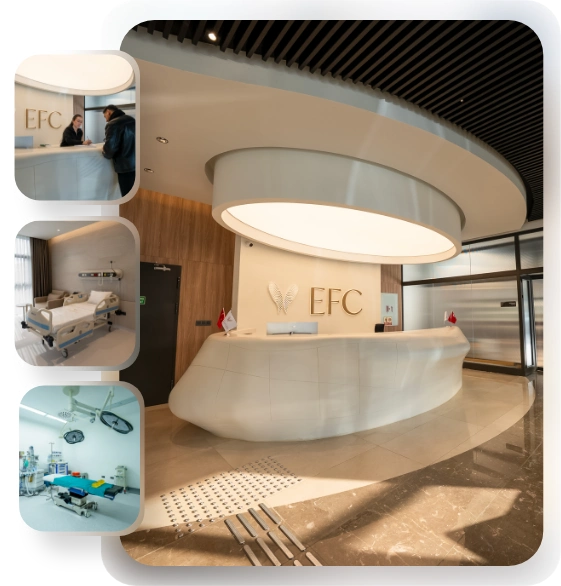
EFC CLINIC
Comprehensive Care: From Initial Consultation to Follow-Up.
EFC CLINIC is a center of excellence specializing in the most meticulous fields of surgical medicine, from aesthetic surgery to interventional treatments—where every step progresses with refined attention. Medical excellence, aesthetic precision, and uncompromising ethical standards converge on the same path. Our subspecialty-trained experts aim to achieve natural and reliable results by delivering evidence-based care supported by modern imaging, standardized protocols, and safety systems. From consultation to recovery, your care is coordinated end-to-end with clear communication, transparent planning, and genuine respect for your health.
Why does breast sagging occur and which factors affect it?
Breast tissue is attached to the chest wall by structures called the “Cooper’s ligaments.” However, these ligaments loosen over time and the skin loses its elasticity. In our consultations with patients, I explain that sagging is not due to a single cause, but is a dynamic process. In particular, the appearance of deflation occurs because the skin has expanded beyond its capacity to retract.
The main factors that accelerate the sagging process are:
- Genetic predisposition
- Pregnancy
- Breastfeeding period
- Frequent weight gain and loss
- Gravity
- Aging
- Menopause
- Skin quality
As a result of these factors, the breast tissue shifts downward and the nipple begins to descend below the inframammary fold line.
Who is a suitable candidate for breast lift surgery?
If you are not happy with the shape of your breasts when you look in the mirror, if your nipples point downward, or if your breasts sit completely low without a bra, you may consider this surgery. For us, the ideal patient profile consists of individuals who have completed physical development, are in good general health, and have realistic expectations about the results of the surgery.
In our clinical evaluation, we observe the following conditions:
- Nipple ptosis
- Skin laxity
- Breast asymmetry
- Enlargement of the areola
- Tissue loss
In particular, we determine the degree of sagging by performing measurements known as the “Regnault Criteria.” If the nipple is at the level of the inframammary fold or lower, surgical intervention may be necessary.
Contact us now to get detailed information about our treatments and procedures and to schedule an appointment!
How should the timing of surgery be planned after breastfeeding?
This is one of the most frequently asked questions from our new-mother patients. During pregnancy and breastfeeding, breast tissue enlarges and stretches as the milk ducts fill. After breastfeeding ends, the tissues shrink (involution) and the breast begins to take its final shape. Completing this process is vital for surgical success.
For the tissues to become stable, we recommend waiting at least 6 months after breastfeeding has stopped, and ideally 1 year. If surgery is rushed before this period has passed, breast tissue may continue to shrink after the operation, and the beautiful, uplifted form we achieve may be compromised. Being patient is the most appropriate step for the quality of the result you will carry for a lifetime.
Which stages are included in the preoperative preparation process?
A successful surgical process begins long before entering the operating room. At the first consultation, we perform a detailed review of medical history. The patient’s medications, past illnesses, and lifestyle are very important to us. At this stage, our strictest rule concerns smoking. Smoking disrupts blood circulation and seriously jeopardizes wound healing. Therefore, we require that smoking be stopped a certain period before surgery.
Points to pay attention to before surgery are:
- Smoking
- Blood-thinning medications
- Herbal supplements
- Vitamin E
- Aspirin
- Green tea
The use of these substances should be discontinued for the period determined by the surgeon. In addition, chronic conditions such as diabetes or hypertension being under control is a prerequisite for safe surgery.
How are breast lift techniques and incisions determined?
In breast lift surgeries, there is no single “right” approach; there is a “patient-specific right.” We decide which technique to use based on the degree of sagging, skin quality, and breast size. Our goal is to achieve the best shape with the least visible scarring.
The main techniques used are:
- Periareolar technique
- Vertical technique
- Inverted-T technique
In the periareolar (Donut) technique, an incision is made only around the nipple and it is preferred for mild sagging. In the vertical (Lollipop) technique, there is a vertical scar descending from the nipple; it is ideal for giving the breast a conical shape in moderate sagging. The inverted-T (Anchor) technique is used in patients with advanced sagging and significant excess skin. In this technique, there is also a scar in the inframammary fold, but it is the method that reshapes the breast most powerfully.
Can breast lift be combined with silicone implants?
Yes, and in fact we often especially recommend this combination (Augmentation-Mastopexy). This is because many patients who present with sagging have not only skin laxity but also significant volume loss. In other words, the breast has “deflated.” If we perform only a lift, the breast is reshaped but may remain small. If the patient wants breasts that are both uplifted and full, implant support is essential.
The method we frequently prefer in these surgeries is the “Dual Plan” (Dual Plane) technique. In this method, the upper part of the implant is placed under the muscle, and the lower part is placed under the breast tissue.
The advantages of the Dual Plan method are:
- Muscle support
- Natural transition
- Implant invisibility
- Long-lasting results
- Lower risk of sagging
With this technique, downward migration of the implant over time is prevented, and a more natural slope is achieved instead of an artificial “ball-like” appearance in the cleavage area.
Contact us now to get detailed information about our treatments and procedures and to schedule an appointment!
How does the surgery and recovery process progress?
The surgery is performed under general anesthesia and may take 2–3 hours depending on the scope of the procedure. Our patients are usually hosted in the hospital for one night. Postoperative pain is the issue our patients worry about the most, but with modern painkillers this period is quite comfortable. Mild pressure and a feeling of tightness in the first few days are completely normal.
Possible experiences during recovery include:
- Swelling
- Bruising
- Numbness
- Tightness
- Mild pain
These symptoms are temporary and decrease over time. After surgery, we have our patients wear a special medical bra for 6 weeks. This bra helps the tissues adapt to their new position. Return-to-work time varies between 3 and 7 days depending on the type of work performed.
Will there be a scar and how does it heal?
Honesty is essential in aesthetic surgery; any procedure that disrupts skin integrity leaves a scar. However, the goal of plastic surgery is to hide these scars within anatomical folds and make them as inconspicuous as possible. In the first months, scars being red and prominent is a natural part of the healing process.
Patience is required for scars to fade over time. Within approximately 6 months to 1 year, scars mature, approach the skin tone, and become less noticeable. To improve scar quality, we use certain products in the postoperative period.
Methods used in scar care include:
- Silicone gels
- Silicone strips
- Moisturizing creams
- Sunscreens
What are the risks and effects on breastfeeding function?
As with any surgical procedure, breast lift surgery has certain risks. Bleeding, infection, or wound-healing issues may occur, although rarely. Temporary changes in nipple sensation can occur, but this usually improves within months as swelling subsides.
Regarding breastfeeding: in the modern techniques we use, the connection (pedicle) between the breast gland, milk ducts, and the nipple is preserved. Since the entire breast tissue is not removed, milk production continues. Therefore, as a rule, this surgery does not prevent your future ability to breastfeed. However, it is best to share your plans with your doctor.
Are the results permanent?
Breast lift surgery is a highly effective procedure that turns back the clock and rejuvenates the breast. However, it is not possible to completely stop the biological clock. Gravity and the aging process will continue. Despite this, the results of a surgery performed with the correct technique are quite long-lasting.
Factors that affect the longevity of results are:
- Weight control
- Skin structure
- Lifestyle
- New pregnancies
- Regular exercise
Avoiding excessive weight fluctuations and maintaining a healthy lifestyle will help you preserve your new form for years. This process is not only a physical change, but also a major step toward feeling better about yourself.
Blog Posts

Most Preferred Countries for Hair Transplantation
Among the most preferred countries for hair transplantation are Turkey, India, South Korea, and Poland. [...]
Read More
21
Jan
Jan

Hair Transplant Prices
Hair transplant prices vary depending on the technique to be used, the number of grafts, [...]
Read More
21
Jan
Jan
Most Preferred Countries for Plastic Surgery
Among the most preferred countries for plastic surgery, Turkey, South Korea, the United States, and [...]
Read More
21
Jan
Jan
Plastic Surgery Prices
Plastic surgery prices vary depending on the type of procedure, geographical location, the surgeon’s experience, [...]
Read More
21
Jan
Jan

Physical Therapy Prices
Physical therapy prices vary depending on the number of sessions to be applied, the treatment [...]
Read More
21
Jan
Jan

Dental Treatment Prices
Dental treatment prices vary depending on the type of procedure to be performed, the quality [...]
Read More
21
Jan
Jan
Most Preferred Countries for Dental Treatments
Among the most preferred countries for dental treatments are Turkey, Hungary, Mexico, and Thailand. These [...]
Read More
21
Jan
Jan