
 Türkçe
 Deutsch
 Français
Breast augmentation surgery is a surgical procedure in which breast volume is permanently increased using silicone implants or fat injection, and asymmetry and shape deformities in the breast are corrected. Known medically as Augmentation Mammoplasty, this procedure aims not only to enlarge the breasts but also to create an aesthetic balance in body contours by harmonizing shoulder width with waist and hip proportions. As the most effective method for correcting developmental deficiencies, post-pregnancy volume loss, or breast tissue that has become depleted after significant weight loss, breast aesthetics restores an ideal shape and fullness that suits the individual’s anatomy.
EFC CLINIC
Comprehensive Care: From Initial Consultation to Follow-Up.
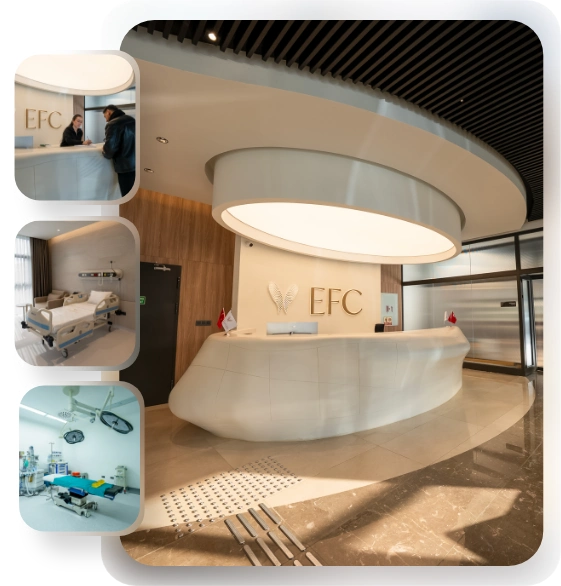
EFC CLINIC is a center of excellence specializing in the most meticulous fields of surgical medicine, from aesthetic surgery to interventional treatments—where every step progresses with refined attention. Medical excellence, aesthetic precision, and uncompromising ethical standards converge on the same path. Our subspecialty-trained experts aim to achieve natural and reliable results by delivering evidence-based care supported by modern imaging, standardized protocols, and safety systems. From consultation to recovery, your care is coordinated end-to-end with clear communication, transparent planning, and genuine respect for your health.
What is breast augmentation surgery and who is it suitable for?
This surgery is essentially a procedure to add volume by placing implants beneath the breast tissue. However, there is no single “right” option for every patient; the process is entirely individualized. In some women, the breast tissue has structurally never developed, while in others the breasts have become deflated after pregnancy or significant weight loss. It is also the most effective method to restore balance in cases of asymmetry where there is a noticeable size difference between the two breasts.
If, in addition to volume deficiency, there is also sagging in the breast tissue, placing an implant alone may not achieve the desired result. In such cases, a breast lift should be performed at the same time as augmentation. This provides fullness while also repositioning the nipple to an ideal location.
Candidate profiles suitable for this surgery include:
- Those with developmental breast smallness
- Those who experience volume loss after childbirth
- Those whose breasts become deflated after significant weight loss
- Those with pronounced breast asymmetry
- Those who need breast reconstruction
How are preoperative planning and implant size determined?
The foundation of a successful result is a detailed preoperative consultation and planning process. Due to safety protocols, especially in patients over the age of 40, it is mandatory to assess the health of the breast tissue. Before surgical planning, mammography and, if necessary, ultrasonography are performed to evaluate whether there is a suspicious cystic structure or mass in the breast tissue. This is the guarantee that the aesthetic process begins with health.
When deciding on implant size, the patient’s preference is of course important, but the body’s limits are also decisive. An ideal range is determined by measuring shoulder width, chest wall structure, and existing skin quality. During surgery, trial implants called “sizers” are used. The surgeon places these temporary implants into the created pocket and evaluates breast position, skin tension, and symmetry in real time. Once the most natural-looking volume is chosen, an unopened, sterile, original implant is placed. This dynamic process eliminates postoperative surprises.
Which breast silicone and implant types are used?
With the advancement of technology, breast implants have undergone a major evolution. Today’s implants have a durable silicone outer shell, while the inner filling material can vary. The most common and gold-standard material is silicone gel. Thanks to “cohesive gel” technology, these implants maintain their shape, are not fluid, and do not disperse even if cut. They also provide the closest feel to natural breast tissue when touched. Saline-filled implants are less preferred today because they can feel firmer and carry a risk of deflation over time.
In terms of shape, two main options are evaluated according to the patient’s anatomy. Round implants are ideal for those who want fullness in the cleavage area. Anatomical, or teardrop-shaped implants, mimic the natural breast slope by providing more volume in the lower portion of the breast.
Implant types include:
- Round silicone implants
- Anatomical (teardrop) silicone implants
- High-profile implants
- Moderate-profile implants
- Low-profile implants
Contact us now to get detailed information about our treatments and procedures and to schedule an appointment!
What is implant surface texture and the risk of BIA-ALCL?
In recent years, the surface texture of implants has become one of the most discussed topics in terms of safety. In the past, textured surfaces were believed to adhere better to tissue. However, scientific studies have shown that certain implants with highly textured surfaces may be associated with a rare type of lymphoma (BIA-ALCL). For this reason, safety is the top priority in the modern surgical approach.
Today, to minimize this risk, smooth-surfaced or new-generation micro-textured implants are generally preferred. To date, no BIA-ALCL cases have been associated with smooth-surfaced implants. Therefore, in order not to put patient health at risk, questionable implant groups are completely avoided and FDA-approved brands with proven reliability are used.
What are the incision sites and the planes where the implant is placed?
Scar management is one of the most delicate aspects of aesthetic surgery. A point of entry is necessary to place the implant, but hiding the scar demonstrates the surgeon’s skill. The most commonly used method is the inframammary fold incision. While this area allows the most controlled placement of the implant, once healing is complete the scar remains hidden within the natural breast crease. Another option is the periareolar incision around the nipple; here the scar is concealed along the transition line between the pigmented area and normal skin.
The layer—or plane—in which the implant is placed determines the naturalness of the result. The “Dual Plane” technique is one of today’s most advanced methods. In this technique, the upper part of the implant is positioned under the muscle, while the lower part is positioned under the breast tissue. This creates a soft transition in the cleavage area provided by the muscle, while preventing the implant edges from being felt or visibly apparent. Especially in thin patients with minimal breast tissue, submuscular or Dual Plane placement prevents an artificial “ball-like” appearance.
Placement techniques used include:
- Submuscular plane
- Subglandular plane
- Dual Plane (double plane)
- Subfascial plane
How is naturalness achieved with the composite breast augmentation technique?
Developed for those seeking perfection in aesthetics, “Composite Breast Augmentation” is the combination of a silicone implant and fat injection. This method is considered a hybrid approach. Placing an implant alone may sometimes not be enough; especially in the cleavage area between the breasts or in thin patients with prominent rib bones, implant edges can be palpable.
In composite surgery, fat harvested from the patient’s own body (abdomen or hips) is processed and injected around the implant and beneath the skin. This fat tissue covers the implant like a soft blanket, providing camouflage. As a result, the volume is provided by silicone, while the softness and natural transition are provided by the patient’s own tissue. This technique elevates the quality of the aesthetic result to a higher level.
Contact us now to get detailed information about our treatments and procedures and to schedule an appointment!
What is the postoperative recovery process like?
The surgery is performed under general anesthesia and takes an average of 1–2 hours. Patients are usually discharged the same day or the next morning. Contrary to common belief, the recovery process is quite comfortable, but following the rules is essential. In the first few days, especially if the implant is placed under the muscle, it is normal to feel pressure and tightness in the breasts. This is the period during which the muscles adapt to stretching and can be managed with simple painkillers.
Special medical bras are used to control swelling and to ensure the implant heals in the correct position. Wearing these bras day and night for approximately 4–6 weeks is critical for maintaining breast shape. Patients can generally return to desk work and social life within 3–5 days. However, strenuous activities should be avoided for a period of time.
Points to pay attention to during recovery include:
- Special medical bra
- Sleeping on the back
- Cold compress application
- Use of prescribed medications
- Protection from the sun
What are possible complications and what is capsular contracture?
As with any surgical procedure, breast augmentation surgery carries rare risks. In the early period, conditions such as infection or blood accumulation (hematoma) can occur at very low rates and are resolved with prompt intervention. In the long term, the term patients most often hear is “Capsular Contracture.” The body perceives the implant as a foreign material and surrounds it with a thin layer (capsule). This is the body’s natural defense mechanism and is an expected process.
However, in some individuals, this capsule may thicken and harden over time, squeezing the implant and causing breast shape distortion or firmness. This is called capsular contracture. With the development of modern textured surfaces and surgical techniques, this rate has decreased significantly. Still, if such a condition develops, a simple surgery to remove the capsule and, if necessary, replace the implant resolves the problem.
Blog Posts

Most Preferred Countries for Hair Transplantation
Among the most preferred countries for hair transplantation are Turkey, India, South Korea, and Poland. [...]
Read More
21
Jan
Jan

Hair Transplant Prices
Hair transplant prices vary depending on the technique to be used, the number of grafts, [...]
Read More
21
Jan
Jan
Most Preferred Countries for Plastic Surgery
Among the most preferred countries for plastic surgery, Turkey, South Korea, the United States, and [...]
Read More
21
Jan
Jan
Plastic Surgery Prices
Plastic surgery prices vary depending on the type of procedure, geographical location, the surgeon’s experience, [...]
Read More
21
Jan
Jan

Physical Therapy Prices
Physical therapy prices vary depending on the number of sessions to be applied, the treatment [...]
Read More
21
Jan
Jan

Dental Treatment Prices
Dental treatment prices vary depending on the type of procedure to be performed, the quality [...]
Read More
21
Jan
Jan
Most Preferred Countries for Dental Treatments
Among the most preferred countries for dental treatments are Turkey, Hungary, Mexico, and Thailand. These [...]
Read More
21
Jan
Jan