
 Türkçe
 Deutsch
 Français
ENT treatments refer to all medical and surgical interventions carried out by the specialty known in medical terms as Otolaryngology–Head and Neck Surgery. These methods focus on diagnosing and managing health problems affecting the ear, nose, sinuses, throat (pharynx and larynx), as well as the head and neck regions. Their scope ranges from hearing loss and balance disorders to chronic nasal obstruction, voice issues, and swallowing problems. These treatments include a broad range of procedures aimed at protecting or improving essential sensory functions and vital processes such as breathing:
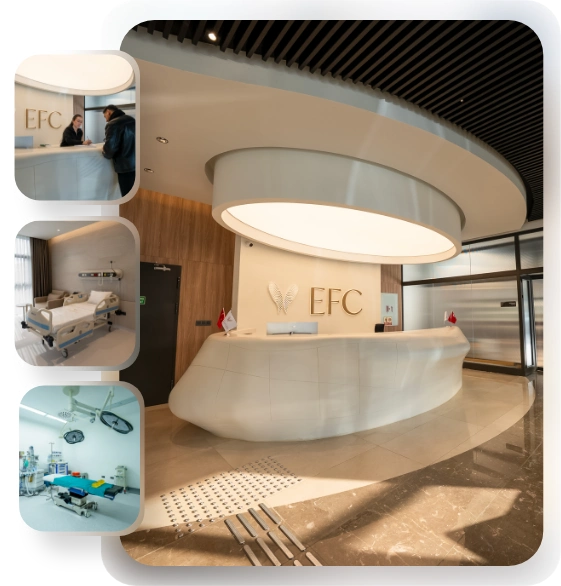
EFC CLINIC
Comprehensive Care: From Initial Consultation to Follow-Up.
EFC CLINIC is a center of excellence specializing in the most meticulous fields of surgical medicine, from aesthetic surgery to interventional treatments—where every step progresses with refined attention. Medical excellence, aesthetic precision, and uncompromising ethical standards converge on the same path. Our subspecialty-trained experts aim to achieve natural and reliable results by delivering evidence-based care supported by modern imaging, standardized protocols, and safety systems. From consultation to recovery, your care is coordinated end-to-end with clear communication, transparent planning, and genuine respect for your health.
What Are the Treatment Methods in the Ear and Balance Field?
The ear is a complex organ that controls not only our hearing but also our balance. Treatments in this field (Otology and Neurotology) focus on these two main functions.
Hearing Loss Surgery: Hearing loss may occur because sound cannot reach the inner ear (conductive type) or due to inner ear/nerve damage (sensorineural). Treatment varies depending on the cause.
One of the most common causes of conductive hearing loss is “Otosclerosis,” meaning calcification of the middle ear ossicles (especially the stapes). When the stapes becomes unable to move, sound is not transmitted. In this case, with microsurgery called “Stapedectomy” or “Stapedotomy,” the calcified ossicle is removed and a tiny piston (prosthesis) that will transmit sound is implanted.
If the loss is very advanced or traditional hearing aids are insufficient due to nerve damage, technological solutions come into play. These include:
- Cochlear Implant (Bionic Ear)
- Bone-Anchored Hearing Devices
A cochlear implant bypasses damaged inner ear structures and directly stimulates the auditory nerve electrically.
Chronic Otitis Media (COM) Surgery: This condition is usually persistent or recurrent middle ear discharge accompanied by a perforation (hole) in the eardrum.
“Tympanoplasty” is the operation to repair the perforated eardrum (patching). This both stops the infection and improves hearing.
Sometimes the inflammation can spread to the mastoid bone behind the ear. Especially if there is an aggressive type of inflammation called “Cholesteatoma,” which has the potential to erode bone, it is essential to remove this infected bony tissue through a “Mastoidectomy” procedure. However, current research shows that if there is no complex condition such as cholesteatoma, repairing only the eardrum perforation (tympanoplasty) is sufficient, and routinely opening the mastoid bone (mastoidectomy) does not make a significant contribution to the outcome.
Vertigo and Ménière’s Disease Management: Vertigo (dizziness) usually originates from the balance system in the inner ear.
The most common cause is “BPPV” (crystal displacement), and its treatment is not medication but specific head-positioning maneuvers such as the “Epley Maneuver.”
However, “Ménière’s Disease” is different. It is a chronic condition caused by increased pressure in the inner ear fluids (inner ear pressure). Typical symptoms of Ménière’s Disease are as follows:
- Attacks of vertigo
- Fluctuations in hearing
- Ringing in the ear (tinnitus)
- A feeling of fullness or pressure in the ear
The goal of Ménière’s treatment is to control symptoms. First-line treatments usually include the following:
- Low-salt diet (Sodium restriction)
- Diuretic (water pill) medications
- Vestibular rehabilitation (Balance physical therapy)
If these treatments are insufficient, steroid or gentamicin injections into the middle ear (intratympanic therapy) may be performed. In more resistant cases, surgical procedures such as cutting the balance nerve (vestibular neurectomy) or reducing inner ear pressure (endolymphatic sac decompression) may be considered.
Which Methods Are Used in Nose and Sinus Treatments?
Rhinology deals with the medical and surgical management of the nose and sinuses (paranasal sinuses). Nasal obstruction and chronic sinusitis are among the problems that most reduce quality of life.
Chronic Sinusitis Surgery: Surgical intervention may be required for sinus inflammation lasting longer than 12 weeks and not responding to medical treatment (Chronic Rhinosinusitis – CRS).
The basis of modern sinus surgery is the method of “Functional Endoscopic Sinus Surgery” (FESS). In this operation, a camera (endoscope) is inserted through the nostrils, the naturally blocked drainage pathways of the sinuses are opened, inflamed tissues and, if present, polyps are removed. The goal is to allow the sinuses to ventilate and clear normally again.
In selected patients with more limited disease and no polyps, “Balloon Sinuplasty” (BSP) is an effective alternative. Just like angioplasty used to open heart vessels, a thin catheter is advanced into the blocked sinus channel and the balloon at its tip is inflated to permanently widen that channel. Recovery time is shorter than with FESS.
Biologic Treatments in Patients with Nasal Polyps: Especially for patients with allergic-based (Type 2 inflammation) nasal polyps that recur continuously despite surgery, “Biologic Treatments” (monoclonal antibodies) have opened a new era. These treatments are monthly or biweekly injections targeting the underlying inflammatory reaction (e.g., interleukins). By reducing or eliminating the need for surgery, they can shrink polyps.
- Nasal Obstruction Surgery: The most common causes of nasal airway obstruction (NAO) are structural problems. In treatment, the following procedures are often combined:
- Septoplasty (Correction of deviation in the nasal septum)
- Turbinate Reduction (Reducing the “nasal turbinates” with radiofrequency or surgery)
Sometimes the cause of obstruction is not a bony deviation but collapse of the nasal roof or alar sidewalls inward during breathing, known as the “nasal valve.” This condition is corrected with “Functional Rhinoplasty.” In this surgery, the goal is usually to strengthen the nasal roof and prevent collapse by using small pieces (grafts) taken from the patient’s own rib or ear cartilage.
Contact us now to get detailed information about our treatments and procedures and to schedule an appointment!
How Are Voice, Swallowing, and Airway Treatments Performed?
Laryngology focuses on problems related to the larynx (voice box). This includes voice (dysphonia), swallowing (dysphagia), and the upper airway (windpipe).
Vocal Cord Paralysis Treatment: Unilateral vocal cord paralysis can develop after thyroid surgeries or certain infections. When the vocal cord cannot close completely, the voice becomes breathy and weak, and liquids may aspirate into the lungs during swallowing.
In this case, there are two main treatment approaches. The first is “Vocal Fold Injection” (VFI). This involves injecting a temporary filler material (usually hyaluronic acid) into the paralyzed vocal fold to bulk it up and bring it closer to the midline. It is usually performed in an office setting under local anesthesia and provides temporary voice improvement.
The permanent solution is “Laryngeal Framework Surgery” (LFS), i.e., “Thyroplasty.” This is an operation considered the “gold standard.” From the outside, a small window is opened on the laryngeal cartilage (thyroid cartilage). Through this window, a special implant (silicone, etc.) is placed to permanently push the paralyzed vocal cord toward the midline.
Swallowing Difficulty (Dysphagia) Management: Dysphagia, i.e., difficulty swallowing, can be a serious problem especially after neurological diseases such as stroke and Parkinson’s disease or after head and neck cancers.
There are two visualization methods considered the “gold standard” for diagnosis:
- Videofluoroscopic Swallow Study (VFSS – Barium swallow study)
- Fiberoptic Endoscopic Evaluation of Swallowing (FEES – Viewing swallowing with a camera through the nose)
Treatment focuses on “Swallowing Rehabilitation.” This includes exercises that strengthen the tongue and pharyngeal muscles, compensatory maneuvers such as “chin tuck” or “effortful swallow,” and sometimes methods such as Neuromuscular Electrical Stimulation (NMES):
Airway Narrowing (Laryngotracheal Stenosis) Surgery: This is a serious narrowing that occurs below the vocal cords (subglottis) or in the windpipe (trachea), usually developing after prolonged ICU intubation or trauma.
In mild strictures, endoscopic (through the mouth) methods (laser, balloon dilation) may be tried.
However, in severe and long strictures, open surgical reconstruction is required. The two main open surgical techniques are as follows:
- Laryngotracheal Reconstruction (LTR) (Widening the airway with a cartilage graft taken from the rib)
- Cricotracheal Resection (CTR) (Completely removing the narrowed segment and suturing the healthy ends end-to-end)
Which Treatments Stand Out in Head and Neck Region Surgeries?
This field focuses on the surgical treatment of all benign and malignant tumors in the head and neck region (mouth, throat, larynx, thyroid, salivary glands).
Transoral Robotic Surgery (TORS): This is a minimally invasive method used especially in the treatment of early-stage (T1–T2) cancers of the throat (oropharynx) and larynx. The surgeon sits at a console and controls thin robotic arms inserted through the patient’s mouth. The advantages provided by the robotic system are as follows:
- Magnified 3-dimensional (3D) vision
- Eliminating tremor of the human hand
- 7 degrees of precise mobility in narrow spaces
Unlike traditional open surgery (opening the neck or jaw), TORS is performed through the mouth without any external incision. Especially in throat cancers associated with HPV (Human Papilloma Virus), it has the potential to provide fewer side effects and better swallowing/speech function compared to chemotherapy and radiotherapy.
Endoscopic Endonasal Approach (EEA) Skull Base Surgery: This is a high-technology method in which neurosurgeons and ENT surgeons work together, using the nostrils as a “corridor.” While it was initially used only for pituitary tumors, today it is also used to reach highly complex tumors such as meningiomas at the skull base. Its advantage is that there is no need to open the skull, there is no facial scarring, and recovery is faster. The most important risk was “Cerebrospinal Fluid (CSF) leak”; however, thanks to modern repair techniques today (such as the nasoseptal flap), this risk rate has become very low.
New Approaches in Thyroid Surgery: Traditional thyroid or parathyroid surgery is performed with an incision made on the front of the neck. However, patients’ desire to avoid a visible neck scar has popularized “remote-access” techniques.
These techniques include the following:
- Transaxillary Approach (Through the armpit)
- Transoral Endoscopic Thyroidectomy (TOETVA)
TOETVA in particular leaves no visible scar on the neck (“scarless” thyroidectomy) by entering through incisions made inside the mouth (between the lower lip and gums).
Salivary Gland (Parotid) Surgery: Most tumors of the preauricular salivary gland (parotid) are benign. The most critical and delicate point of this surgery (Parotidectomy), regardless of the tumor type, is preserving the “facial nerve.” This nerve, which controls all facial expressions (smiling, blinking), passes right through the middle of the parotid gland. Surgery requires carefully identifying and protecting each branch of this nerve.
Contact us now to get detailed information about our treatments and procedures and to schedule an appointment!
What Is the Approach in Pediatric ENT Treatments?
Pediatric ENT (Pediatric Otolaryngology) deals with both very common (tonsils, adenoids) and complex (congenital airway anomalies) conditions. Over the last decade, especially thanks to the guidelines of the American Academy of Otolaryngology (AAO-HNS), there has been a radical change in surgical decisions. Now, “watchful waiting” is encouraged to prevent unnecessary surgeries, and very clear numerical criteria are defined for surgery.
What Are the Criteria for Tonsil Surgery (Tonsillectomy)?
According to guidelines, there are two main reasons for surgery. The first is recurrent infections. Just having “frequent throat infections” is not a sufficient criterion. For surgery to be an option, strict frequency thresholds known as the “Paradise Criteria” must be met.
These criteria are as follows:
- 7 or more episodes in the past 1 year
- 5 or more episodes per year in the past 2 years
- 3 or more episodes per year in the past 3 years
It is not enough for these episodes to be only “sore throat”; each episode must be medically documented and include at least one of the following findings:
- Fever (above 38.3°C)
- Painful swollen lymph nodes in the neck
- Tonsillar exudate (pus)
- Positive Group A Streptococcus test
The second main reason is “Obstructive Sleep Apnea” (OSA). That is, snoring and breathing pauses during sleep due to enlarged tonsils and adenoids. Especially in children with additional risk factors such as Down syndrome or obesity, documenting apnea with “Polysomnography (PSG),” i.e., a sleep test, is mandatory before surgery.
When Is Ear Tube Placement (Tympanostomy) Necessary?
Ear tubes are now applied much more selectively.
In children with “Recurrent Acute Otitis Media” (R-AOM), i.e., frequent middle ear infections, tube placement is recommended only if the presence of fluid (effusion) in the middle ear has been documented during these episodes.
For the most common cause, “Otitis Media with Effusion” (OME), i.e., fluid accumulation in the middle ear for less than 3 months, “watchful waiting” is recommended because many cases resolve spontaneously. Tubes should be recommended only in the following situations:
- If the middle ear fluid has been present for 3 months or longer (chronic)
- If this fluid accumulation is accompanied by documented hearing loss
- If there are balance problems or speech delay related to the condition
What Are Congenital Problems?
The most common cause of noisy breathing (stridor) in infants is “Laryngomalacia” (LM). This is the congenital softness of the laryngeal cartilages and their collapse inward during breathing. Most cases are mild and resolve spontaneously as the baby grows (12–18 months). Surgery (“Supraglottoplasty”) is reserved only for severe cases with feeding problems or significant respiratory distress.
Where Does Facial Aesthetic Surgery Fit Within ENT Treatments?
Facial Plastic and Reconstructive Surgery (FPRS) is an important subspecialty of ENT. This field includes both reconstructive (repairs after cancer or trauma) and cosmetic procedures.
Prominent Ear (Otoplasty) Surgery: This is the operation to correct prominent ears (prominauris), and patient satisfaction is very high. Current surgical philosophy has shifted from older “cartilage-cutting” techniques toward “cartilage-sparing” techniques that provide more natural aesthetic results.
The goal is not simply to “pin the ears back,” but to permanently recreate the folds that are anatomically missing in the prominent ear by using permanent sutures.
The two most common cartilage-sparing techniques are as follows:
- Mustardé Technique (Creates the missing upper ear fold (antihelix))
- Furnas Technique (Pulls back the deep conchal bowl that pushes the ear away from the head)
Functional Rhinoplasty: This is a procedure that combines both the Rhinology (breathing) and Facial Plastic (shape) aspects of ENT. As mentioned in the nasal obstruction section, while correcting collapses (nasal valve) in the nasal roof or sidewalls, it also aims to improve nasal aesthetics.
Blog Posts

Most Preferred Countries for Hair Transplantation
Among the most preferred countries for hair transplantation are Turkey, India, South Korea, and Poland. [...]
Read More
21
Jan
Jan
Hair Transplant Prices
Hair transplant prices vary depending on the technique to be used, the number of grafts, [...]
Read More
21
Jan
Jan
Most Preferred Countries for Plastic Surgery
Among the most preferred countries for plastic surgery, Turkey, South Korea, the United States, and [...]
Read More
21
Jan
Jan

Plastic Surgery Prices
Plastic surgery prices vary depending on the type of procedure, geographical location, the surgeon’s experience, [...]
Read More
21
Jan
Jan

Physical Therapy Prices
Physical therapy prices vary depending on the number of sessions to be applied, the treatment [...]
Read More
21
Jan
Jan

Dental Treatment Prices
Dental treatment prices vary depending on the type of procedure to be performed, the quality [...]
Read More
21
Jan
Jan

Most Preferred Countries for Dental Treatments
Among the most preferred countries for dental treatments are Turkey, Hungary, Mexico, and Thailand. These [...]
Read More
21
Jan
Jan