
 Türkçe
 Deutsch
 Français
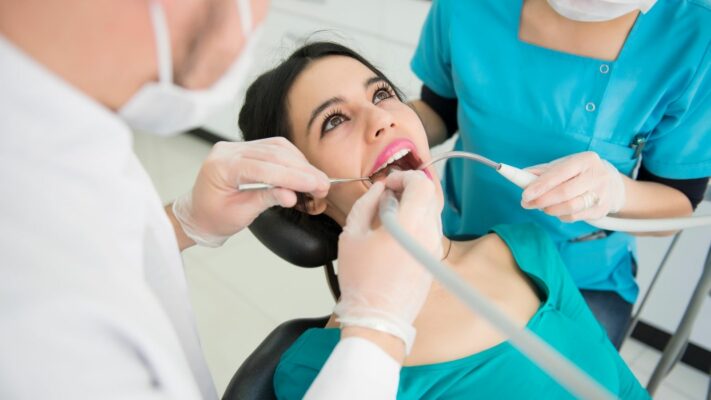
Porcelain crown treatment is the restoration of teeth that have suffered loss of structure, have fractured, or have lost their aesthetic form by completely covering them with materials that mimic the tooth’s natural structure. Classified as a fixed prosthesis in dentistry, this procedure protects weakened tooth structure like armor against external factors while fully restoring lost chewing function and aesthetic appearance. Permanently fixed to the tooth by the dentist with special adhesives, these crowns enable the patient to feel as if it is their own tooth and allow teeth whose structural integrity has been compromised to remain healthy in the mouth for many years.
EFC CLINIC
Comprehensive Care: From Initial Consultation to Follow-Up.
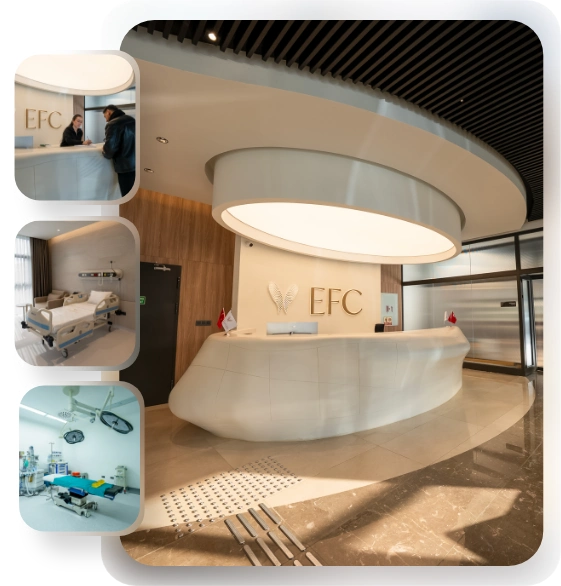
EFC CLINIC is a center of excellence specializing in the most meticulous fields of surgical medicine, from aesthetic surgery to interventional treatments—where every step progresses with refined attention. Medical excellence, aesthetic precision, and uncompromising ethical standards converge on the same path. Our subspecialty-trained experts aim to achieve natural and reliable results by delivering evidence-based care supported by modern imaging, standardized protocols, and safety systems. From consultation to recovery, your care is coordinated end-to-end with clear communication, transparent planning, and genuine respect for your health.
Why and in which situations is porcelain crown treatment needed?
Our teeth wear out over time for various reasons and sometimes reach a point where they cannot be saved with a simple filling. The main purpose of a crown is to keep the tooth in the mouth and extend its lifespan. It is not only an aesthetic touch but also a serious engineering solution. If there is very large loss of tooth structure, placing a filling can be risky because the remaining tooth structure may not withstand chewing pressure and may fracture. At this point, the crown encircles the tooth like a band, distributes the force, and prevents fracture.
The situations in which we most often need this treatment are as follows:
- Severely decayed teeth
- Teeth fractured due to trauma
- Teeth that have undergone root canal treatment
- Weak teeth with large fillings
- Discolored teeth
- Teeth with shape deformities
- Spaced tooth alignment
- Old and incompatible crowns
How do porcelain crown materials differ from natural teeth?
The issue patients most frequently ask about and worry about in the chair is whether the restored tooth will look “artificial.” Because older materials were more matte and opaque, it could be understood that it was a prosthesis when looked at carefully. However, modern ceramics produced with today’s technology have the ability to replicate natural tooth enamel exactly.
The most important feature of a natural tooth is that it can transmit light (translucency). Light enters the tooth, refracts, and creates a soft reflection. This adds depth and vitality to the tooth. The new-generation porcelains we use also have this feature. In a challenging environment like the mouth, which is constantly wet, acidic, and subject to temperature changes, these materials do not change color, show resistance to wear, and most importantly achieve perfect biological harmony with the gums.
Why are metal-supported porcelain crowns not preferred as much as they used to be?
Metal-supported porcelains, which were indispensable in dentistry for many years, had proven their strength, but they also brought some aesthetic disadvantages. In this system, a gray metal framework is placed underneath to prevent the porcelain from fracturing. To mask that gray color of the metal, a layer called an “opaquer,” which does not transmit light at all, is applied over it.
No matter how much effort is made, this causes the tooth to lose its natural perception of depth and to appear somewhat dull. In addition, when physiological gum recession occurs over time, a thin gray metal reflection line may appear at the border between the tooth and the gum. This “gray shadow” is a condition that disrupts smile aesthetics, especially in anterior teeth. Today, since our patients demand not only strength but also flawless aesthetics, metal substructures are being replaced by more modern materials.
Contact us now to get detailed information about our treatments and procedures and to schedule an appointment!
How does zirconia combine aesthetics and strength?
Zirconia is revolutionary in dentistry. Also called “white steel,” this material melts the durability of metal and the elegance of porcelain into a single crucible. Zirconium oxide is structurally so strong that it can resist high chewing forces and teeth clenching problems.
The biggest advantage of this material is that despite containing no metal, it is very durable and also has light translucency. There is no risk of the gray reflection seen with metal substructures in zirconia. In this way, it meets aesthetic expectations in anterior teeth and provides the load-bearing capacity needed in posterior teeth. It is also a tissue-friendly material; its compatibility with the gums is excellent, and it is a safe harbor for patients with metal allergies.
The advantages of zirconia use are as follows:
- High fracture resistance
- Natural light translucency
- Tissue-friendly structure
- Thermal insulation
- No allergy risk
- Gum compatibility
In which situations is an all-ceramic (E-max) crown used?
If our goal is an appearance that is “so perfect it cannot be distinguished from a natural tooth,” all-ceramics come into play, namely glass ceramics such as E-max or Empress. These crowns contain no metal or zirconia substructure in any way; they are produced entirely from reinforced porcelain. Their light refraction and reflection properties are the closest material to natural tooth enamel.
Especially in anterior teeth (incisors), in cases where translucency and shade transitions are very critical, all-ceramics are unrivaled. However, there is a price for this high aesthetics: they do not have as much flexibility and resistance as zirconia. Therefore, they are generally not preferred in cases where there are missing teeth and a bridge is required (meaning there is a gap in between). E-max crowns are ideal more for situations where individual teeth are crowned and aesthetics are at the forefront.
What is the difference between laminate veneer and a porcelain crown?
These two methods are often confused, but their application logic is actually quite different. To explain with a simple example: Laminate Veneer (porcelain veneer) is like a false fingernail; it is very thin porcelain shells bonded only to the front surface of the tooth. A crown, on the other hand, is like a thimble placed over a finger; it encircles the tooth from all sides and protects it.
Veneers require minimal intervention to tooth structure. They are applied with very slight reduction from the front surface of the tooth. However, if there is major loss of structure in your tooth, if it has undergone root canal treatment, or if it has structurally weakened, a shell bonded only to the front surface is not enough to protect the tooth. In this case, we need a crown that encircles the tooth completely. When deciding, our main criterion is how much of the existing tooth remains strong.
Contact us now to get detailed information about our treatments and procedures and to schedule an appointment!
How do digital dentistry and CAD/CAM technology affect the process?
Those large trays placed in your mouth and the nauseating, dough-like impression materials are becoming history. In modern clinics, this process has become fully digital. Thanks to CAD/CAM technology, we can obtain a 3D image of your teeth within seconds using intraoral scanner cameras.
This digital impression is processed in a computer environment with micron-level precision, and your new tooth is designed virtually. Then, special devices mill this design from ceramic blocks. The greatest comfort this technology offers the patient is that the process becomes faster and the margin of error drops to zero. The junction line of digitally produced crowns with the tooth is so perfect that bacterial leakage and the related risk of decay are minimized.
What should be considered after a porcelain crown?
When your new teeth are placed, it is completely normal to feel a sense of foreignness in your mouth. It may take a few days for your tongue and cheeks to adapt to this new situation. However, for the lifespan and success of the crown, there are certain rules you should pay attention to especially in the first days. After the bonding procedure we call cementation, it takes time for the cement to reach full hardness.
The foods to be avoided during this period are as follows:
- Turkish delight
- Chewing gum
- Sticky candies
- Hard nuts
- Ice
There is also an important issue we call occlusion control. Even if you leave our clinic happily after your crowns are placed, you may feel “highness” while chewing. In order to understand how the teeth contact each other while your jaw is in motion, we apply the “8-hour rule.” After using your new teeth for at least 8 hours, eating and speaking, if you feel a specific spot hitting or causing pain, your dentist can identify and adjust that point much more easily.
How should care be to extend the lifespan of crowned teeth?
There is a very wrong belief among the public, such as “A crown was done, that tooth will not decay anymore.” Yes, porcelain itself does not decay, but your own tooth underneath the porcelain is still alive and susceptible to decay. If you do not clean the junction line between the crown and the gums well, bacteria can seep through that microscopic gap and decay the main tooth under the crown. Since this is not visible from the outside, it is a stealthy process.
For this reason, you should take even more care of your crowned teeth than your natural teeth. Brushing twice a day is the basic rule, but it is not enough. Interproximal areas that the brush cannot reach and the underside of bridge pontics are the favorite hiding spots for bacteria. Using dental floss and interdental brushes is the most critical factor that determines the lifespan of your crown. With good care and regular check-ups, a high-quality porcelain crown can serve you for many years, even for life, without problems.
Blog Posts

Most Preferred Countries for Hair Transplantation
Among the most preferred countries for hair transplantation are Turkey, India, South Korea, and Poland. [...]
Read More
21
Jan
Jan

Hair Transplant Prices
Hair transplant prices vary depending on the technique to be used, the number of grafts, [...]
Read More
21
Jan
Jan
Most Preferred Countries for Plastic Surgery
Among the most preferred countries for plastic surgery, Turkey, South Korea, the United States, and [...]
Read More
21
Jan
Jan
Plastic Surgery Prices
Plastic surgery prices vary depending on the type of procedure, geographical location, the surgeon’s experience, [...]
Read More
21
Jan
Jan

Physical Therapy Prices
Physical therapy prices vary depending on the number of sessions to be applied, the treatment [...]
Read More
21
Jan
Jan

Dental Treatment Prices
Dental treatment prices vary depending on the type of procedure to be performed, the quality [...]
Read More
21
Jan
Jan
Most Preferred Countries for Dental Treatments
Among the most preferred countries for dental treatments are Turkey, Hungary, Mexico, and Thailand. These [...]
Read More
21
Jan
Jan