
 Türkçe
 Deutsch
 Français
Dental crown treatment is the restoration of teeth that have suffered loss of structure due to decay, fracture, trauma, or genetic reasons by encircling them with tissue-compatible special materials. Applied under the discipline of prosthetic dentistry, this method restores lost chewing function and phonetics while also bringing smile aesthetics to an ideal form. Thanks to current materials used in modern dentistry such as zirconium, e-max, and laminate veneers, the light translucency and durability of natural tooth enamel are replicated exactly. In this way, both oral health is preserved and the self-confidence patients need in their social lives is rebuilt through long-lasting and biologically compatible restorations.
EFC CLINIC
Comprehensive Care: From Initial Consultation to Follow-Up.
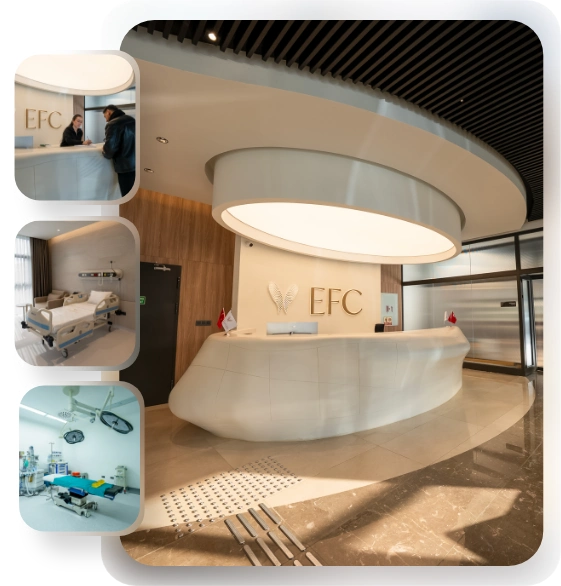
EFC CLINIC is a center of excellence specializing in the most meticulous fields of surgical medicine, from aesthetic surgery to interventional treatments—where every step progresses with refined attention. Medical excellence, aesthetic precision, and uncompromising ethical standards converge on the same path. Our subspecialty-trained experts aim to achieve natural and reliable results by delivering evidence-based care supported by modern imaging, standardized protocols, and safety systems. From consultation to recovery, your care is coordinated end-to-end with clear communication, transparent planning, and genuine respect for your health.
What Is Prosthetic Dental Treatment and What Does It Include?
When you hear prosthetic treatment, don’t let complex medical terms come to mind. In its simplest form, this field is the art of completing parts of the teeth and surrounding tissues that have been lost for various reasons with custom-made artificial materials. For us dentists, the priority is always to preserve the patient’s own natural tooth. However, sometimes the damage is so extensive that we need external support to keep the tooth in the mouth or to replace a missing tooth.
The scope of these treatments is quite broad. We are talking about a range that extends from a precise crown placed on a single tooth to implant-supported restorations involving the entire jaw. Our goal is not just to create a white appearance. It aims for the patient to be able to eat comfortably, pronounce words properly, and improve facial aesthetics as a whole. Fixed prostheses are comfortable solutions that the patient cannot remove, permanently cemented onto teeth or implants.
In Which Situations Is Dental Crowning, That Is, Crown Treatment Necessary?
Crowns, known among the public as “caps,” involve restoring the visible part of the tooth by encircling it completely. Why would we need to crown a tooth entirely? Generally, we choose this route when the tooth has been damaged so severely that it cannot be saved with a simple filling. A crown protects the weakened tooth like a helmet against external factors and chewing forces.
Common situations where crown treatment is needed are as follows:
- Deep cavities
- Large structural losses
- Fractures due to accidents
- Teeth that have undergone root canal treatment
- Implant-supported structures
- Shape deformities
- Discolorations
Especially after root canal treatment, teeth lose vitality and become brittle over time like a “dried branch.” Even if the roots of these teeth are solid, their upper structures are weak. At this point, crowns serve as a protective shield that extends the life of the tooth.
Contact us now to get detailed information about our treatments and procedures and to schedule an appointment!
What Is Bridge Treatment and What Are Its Types in Replacing Missing Teeth?
When one or more teeth are missing in the mouth, restorations made by taking support from the teeth on both sides of the gap are called a “bridge.” The logic is exactly the same as an architectural bridge. The healthy teeth on both sides of the gap function as bridge abutments and support the artificial tooth (pontic) that will fill the space in between. In this way, integrity in the dental arch is restored.
Failing to fill the missing tooth space can cause adjacent teeth to tip toward the gap or the opposing tooth to over-erupt into the space. This can lead to bite problems in the long term. Depending on the clinical situation, we can apply different bridge designs.
Commonly applied types of bridges are as follows:
- Traditional dental bridges
- Cantilever dental bridges
- Maryland dental bridges
- Implant-supported bridges
Today, the approach most consistent with the philosophy of “conservative dentistry” is implant-supported solutions. Because with this method, we do not need to cut down and reduce the healthy teeth next to the gap. Artificial roots (implants) placed in the position of the missing tooth support the bridge, and sound tooth structure is preserved.
Who Are Laminate Veneers Applied To That Meet Aesthetic Expectations?
Laminate veneers have created virtually a revolution in aesthetic dentistry. Also known as “porcelain veneers,” this method involves bonding very thin porcelain shells, about the thickness of a fingernail, only to the front surface of the tooth rather than cutting the entire tooth surface. This treatment is called “minimally invasive,” meaning we aim to achieve the highest aesthetic result with the least intervention to the tooth.
The main situations in which laminate veneers are preferred are as follows:
- Stubborn discolorations
- Diastema (gapped teeth)
- Mild crowding
- Shape deformities
- Chipped tooth edges
- Worn tooth surfaces
The biggest advantage of this procedure is that very little (0.3 – 0.7 mm) tooth structure is removed, or in some cases it can be applied without any reduction at all. When bonded with the correct technique, it integrates with the tooth and can be used safely for many years.
Why Should Zirconium Be Preferred Instead of Metal-Supported Porcelain?
For many years, gray metal alloys were used under porcelain teeth to provide durability. However, since these metals block light transmission, it was difficult to replicate the natural translucent appearance of the tooth. In addition, over time they could create a gray reflection or a purplish discoloration at the gum margin.
Today, material science has advanced significantly, and “All-Ceramic” systems—especially Zirconium—have come to the forefront. Zirconium is an oxide ceramic material that is as durable as a kind of “white metal.” It is strong enough to withstand chewing forces in posterior teeth and is also perfectly compatible biologically with the gums. It carries no risk of metal allergy and provides a much more vibrant appearance by transmitting light like a natural tooth.
The prominent features of zirconium crowns are as follows:
- High durability
- Tissue-friendly structure
- Natural light translucency
- Thermal insulation
- Color stability
Contact us now to get detailed information about our treatments and procedures and to schedule an appointment!
What Aesthetic Advantages Do E-Max Crowns Provide?
If our goal is “perfect aesthetics” and we are working especially on anterior teeth, the first option that usually comes to mind is E-Max, that is, lithium disilicate glass ceramics. This material contains glass particles, which gives it even higher translucency and naturalness than zirconium.
E-Max crowns are the material closest to natural tooth enamel in terms of light refraction and reflection properties. Therefore, they are indispensable for dentists in aesthetic restorations of the front teeth. It is a more delicate material compared to zirconium, but its ability to chemically bond to the tooth is very high.
The areas where E-Max material is used are as follows:
- Anterior crowns
- Laminate veneers
- Inlay restorations
- Onlay restorations
How Does the Treatment Process Progress Step by Step in the Clinic?
A crown treatment is generally a process that takes 2 to 4 sessions and is completed in about a week in total. The first stage is always a detailed examination and planning. The root health of the tooth is evaluated with X-rays. Then we move on to the preparation stage, which we call “preparation.” Decay on the tooth is removed and the area where the crown will sit is created.
In many clinics, the impression-taking process can now be done within seconds using digital scanners, without the nausea sensation caused by traditional putty-like materials. One of the most wondered-about issues is the waiting period. Our patients are never left without teeth. In the session when impressions are taken, “temporary crowns” that protect the teeth and provide aesthetics are applied immediately. While the permanent teeth are being prepared in the laboratory, the patient continues their social life.
The main stages in the treatment process are as follows:
- Examination
- Tooth preparation
- Impression taking
- Temporary crown
- Laboratory fabrication
- Try-in
- Cementation
Why Are the Bonding Procedure and Adhesive Cementation Critical for Crowns?
Our patients sometimes worry, “Will my crown fall off?” In modern dentistry, especially for laminate and all-ceramic restorations, the technique we use is not simple gluing but an “adhesive cementation,” that is, a chemical fusion process. This stage is the most critical point that determines the success of the treatment.
This process requires complete isolation; the tooth and the crown must definitely be kept away from moisture. Separate chemical agents are applied to the inner surface of the ceramic restoration and to the tooth surface. These steps involve a sensitive protocol measured in seconds and requiring strict adherence to the rules:
The materials used during cementation are as follows:
- Hydrofluoric acid
- Silane agent
- Orthophosphoric acid
- Bonding agent
- Resin cement
What Should Pre-Treatment Planning and Gum Health Be Like?
Before starting treatment, it is the most natural right of our patient to know what the result will look like. Therefore, we perform digital smile design and “Mock-up” applications. Without touching the teeth at all, a copy of the design is temporarily applied in the patient’s mouth. Thus, the patient can experience the final appearance in advance.
In addition, gum health—what we call “Pink Aesthetics”—is as important as white aesthetics. Even the most beautiful porcelain looks bad on inflamed, bleeding, or uneven gum levels. Therefore, it is essential that the gums are completely healthy and symmetrical before crowning.
The points considered before treatment are as follows:
- Smile design
- Mock-up try-in
- Gum levels
- Periodontal health
- Bite analysis
How Should Maintenance Be Done to Extend the Lifespan of Crowns?
After the treatment is finished, the responsibility falls to our patient. The thought “Since it’s a crown, it won’t decay anyway” is extremely wrong. The crown itself does not decay, yes, but your own tooth underneath is still vulnerable to decay. Especially the margins of the crown can be suitable areas for bacteria to accumulate. Therefore, maximum attention should be paid to oral hygiene.
In patients with a teeth grinding (bruxism) habit, using a night guard is vital to prevent porcelain fractures. In addition, it is necessary to avoid cracking hard-shelled foods with the teeth. Regular dental check-ups are required to resolve potential problems before they grow.
Recommendations for crown maintenance are as follows:
- Regular brushing
- Flossing
- Interdental brushes
- Night guard
- Dental check-ups
- Mouthwash use
Blog Posts

Most Preferred Countries for Hair Transplantation
Among the most preferred countries for hair transplantation are Turkey, India, South Korea, and Poland. [...]
Read More
21
Jan
Jan

Hair Transplant Prices
Hair transplant prices vary depending on the technique to be used, the number of grafts, [...]
Read More
21
Jan
Jan
Most Preferred Countries for Plastic Surgery
Among the most preferred countries for plastic surgery, Turkey, South Korea, the United States, and [...]
Read More
21
Jan
Jan

Plastic Surgery Prices
Plastic surgery prices vary depending on the type of procedure, geographical location, the surgeon’s experience, [...]
Read More
21
Jan
Jan

Physical Therapy Prices
Physical therapy prices vary depending on the number of sessions to be applied, the treatment [...]
Read More
21
Jan
Jan

Dental Treatment Prices
Dental treatment prices vary depending on the type of procedure to be performed, the quality [...]
Read More
21
Jan
Jan
Most Preferred Countries for Dental Treatments
Among the most preferred countries for dental treatments are Turkey, Hungary, Mexico, and Thailand. These [...]
Read More
21
Jan
Jan