
 Türkçe
 Deutsch
 Français
Brazilian Butt Lift, known in medical literature as the Brazilian Butt Lift (BBL), is an aesthetic surgical procedure in which excess fat tissue taken from areas such as the abdomen, waist, or back is purified and transferred to the buttock region, thereby giving the buttocks more volume, lift, and a rounder shape. Beyond being a localized buttock augmentation operation, this method is a holistic body contouring procedure that also includes removing regional excesses with liposuction, defining the waistline and giving the body an “hourglass” appearance. Since this technique does not involve synthetic implants or artificial filler materials and uses the patient’s own autologous fat as the primary material, the results obtained are extremely natural both visually and to the touch, and are biologically compatible.
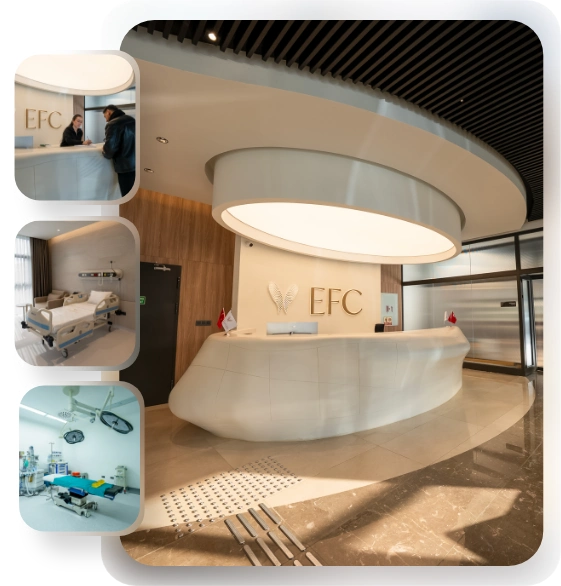
EFC CLINIC
Comprehensive Care: From Initial Consultation to Follow-Up.
EFC CLINIC is a center of excellence specializing in the most meticulous fields of surgical medicine, from aesthetic surgery to interventional treatments—where every step progresses with refined attention. Medical excellence, aesthetic precision, and uncompromising ethical standards converge on the same path. Our subspecialty-trained experts aim to achieve natural and reliable results by delivering evidence-based care supported by modern imaging, standardized protocols, and safety systems. From consultation to recovery, your care is coordinated end-to-end with clear communication, transparent planning, and genuine respect for your health.
What is the basic logic of the Brazilian Butt Lift (BBL) procedure?
The most important feature that distinguishes this operation from other aesthetic interventions is that it provides a “two-way gain.” The philosophy of the procedure is based on the principle of removing excess from one area of the body and transferring it to another area where there is a deficiency. BBL surgery is actually the combination of two main stages: liposuction and fat injection.
In the first step, stubborn fat deposits are removed from areas of the body prone to fat accumulation, such as the abdomen, the flanks (love handles), or the back. This step deepens the waist indentation and slims the upper body. A slimmer waist creates an optical illusion that makes the buttocks look more prominent even before anything is done to the buttocks. In the second step, the removed fats are processed through special procedures and injected into the upper and middle parts of the buttocks. As a result, the patient ends up with both a slimmer waist and fuller curves. This method is the most organic option with the highest tissue compatibility for achieving the body’s natural harmony.
Who is an ideal candidate for Brazilian Butt Lift?
As with every aesthetic procedure, the most critical factor that determines success in the BBL procedure is correct patient selection. Not everyone may be suitable for this procedure because it is a “transfer” procedure, and it requires capital to transfer, namely fat. For an ideal candidate, meeting certain criteria is essential both for the success of the aesthetic outcome and for the patient’s safety.
The criteria evaluated in terms of suitability for this procedure are as follows:
- Individuals with sufficient fat reserves
- Those with a body mass index within an appropriate range
- Individuals with realistic expectations
- Patients with good skin elasticity
- Non-smokers
- Those in good overall health
- Individuals who have not experienced major weight changes recently
If the person’s body fat percentage is very low and there is not enough fat to harvest, BBL may unfortunately not deliver the desired result. In this case, alternative methods should be discussed. Likewise, in patients with excessive skin laxity in the buttock region, filling alone may not be sufficient, and lifting procedures may be required.
Contact us now to get detailed information about our treatments and procedures and to schedule an appointment!
What are the methods and stages applied during the surgery?
A successful BBL operation is not a random fat transfer but a meticulous process based on biological principles. This process generally consists of three main stages, and each stage is built on preserving the viability of the fat cells.
The first stage is harvesting the fat. The liposuction technique used here is slightly different from classical fat removal procedures. The goal is not only to remove fat but to collect the cells alive. Therefore, special atraumatic cannulas that do not damage the tissue are used. The fat cells are harvested gently, under low pressure.
The second stage is purification. The fat taken from the body contains blood, serum, and damaged cells. Injecting this mixture directly increases the risk of infection and reduces longevity. Therefore, the harvested material is washed, filtered, or centrifuged. What remains is only a pure, golden-yellow, stem-cell-rich fat tissue.
The third stage is injection. This valuable purified tissue is not delivered in large amounts from a single point into the buttocks. The surgeon uses very fine cannulas to distribute the fat in small droplets into the subcutaneous tissues at different levels. This technique allows each fat cell to be nourished by the surrounding healthy tissue.
How are safety and the risk of fat embolism managed in this procedure?
Safety is the issue our patients ask about most in BBL surgeries and the one we focus on the most. Due to some negative experiences in the past, the risks of this surgery have come to the forefront; however, thanks to modern techniques and strict protocols used today, BBL has become an extremely safe procedure. The most basic safety rule here is related to where the fat is injected.
According to international standards, the only accepted safe method is the “Subcutaneous Injection” technique. Fat tissue must never be injected into or beneath the gluteal muscle. Muscle tissue is an area where large vessels are dense, and injections made there can pose a risk of fat embolism. However, injections into the fat pad between the skin and the muscle are safe in terms of vascular anatomy.
Surgeons are now much more aware in this regard and act by using the opportunities offered by technology. During the operation, the position of the cannula tip is continuously monitored, and the muscle tissue is strictly avoided. With correct surgical technique and anatomical knowledge, the risk of embolism is almost completely eliminated.
Should BBL or buttock implants be preferred?
There are two main paths in buttock aesthetics: one is the patient’s own tissue (BBL), and the other is silicone prostheses (implants). Which one should be chosen depends on the patient’s body structure. BBL is always our first choice because it feels the most natural to the touch, leaves no scars, and also shapes other areas of the body. However, in some cases, implants may be an unavoidable option.
The situations in which buttock implants may be preferred are as follows:
- Individuals with very low body fat percentage
- Extremely thin patients
- Those who want very prominent projection
- Those who desire a firmer tissue
- Those who do not want to take the risk of fat resorption
Implants provide permanent volume, but the natural feel to the touch may not be as soft as BBL. Sometimes a hybrid method we call “Composite” is applied; that is, an implant is placed and the top is covered with fat to provide a soft transition.
Contact us now to get detailed information about our treatments and procedures and to schedule an appointment!
What is the postoperative recovery process and what should be considered?
If the success of the surgery is 50% in the surgeon’s hands, the other 50% depends on the patient’s discipline during the recovery process. The most critical period after BBL is the first 6 weeks. When the transferred fat cells are placed in their new location, they do not yet have their own blood vessel connections. They are nourished by oxygen that seeps from the surrounding tissues. Pressure applied during this period can cause the cells to die.
For this reason, there are strict rules that patients must follow. These are as follows:
- Not sitting directly on the buttocks
- Not lying on the back
- Lying face down or on the side
- Using a special BBL pillow
- Wearing a tight compression garment
- Drinking plenty of water
- Avoiding smoking
- Getting lymphatic massage
- Avoiding heavy exercise
We generally recommend that our patients do not sit at all for the first 2 weeks after surgery, except for using the toilet. Afterwards, sitting is allowed with special pillows, placing the load on the thighs. This process may seem a bit demanding, but it is of vital importance for the permanence of the result to be achieved. In addition, wearing a compression garment is necessary for reducing edema in the areas where liposuction was performed and for the skin to adapt to its new form.
How permanent are the results, and is there resorption over time?
Our patients’ biggest concern is the question, “Will my fat resorb after surgery?” To be honest, yes, a portion of the transferred fat is absorbed by the body. This is a biological process and cannot be prevented. Generally, 30% to 40% of the transferred fat is metabolized by the body within the first few months. However, the remaining 60–70% is permanent.
The remaining fat cells establish new vascular connections in that area and begin to behave like fat tissue in other parts of the body. In other words, the “surviving fat” does not resorb and disappear; it continues to live there. However, because these cells are alive, they are affected by the patient’s weight changes. If the patient gains weight, the buttocks enlarge; if the patient loses weight, they shrink.
The factors affecting permanence are as follows:
- The technique used by the surgeon
- Postoperative care
- Dietary habits
- Weight stability
- Metabolic rate
Blog Posts

Most Preferred Countries for Hair Transplantation
Among the most preferred countries for hair transplantation are Turkey, India, South Korea, and Poland. [...]
Read More
21
Jan
Jan
Hair Transplant Prices
Hair transplant prices vary depending on the technique to be used, the number of grafts, [...]
Read More
21
Jan
Jan
Most Preferred Countries for Plastic Surgery
Among the most preferred countries for plastic surgery, Turkey, South Korea, the United States, and [...]
Read More
21
Jan
Jan
Plastic Surgery Prices
Plastic surgery prices vary depending on the type of procedure, geographical location, the surgeon’s experience, [...]
Read More
21
Jan
Jan
Physical Therapy Prices
Physical therapy prices vary depending on the number of sessions to be applied, the treatment [...]
Read More
21
Jan
Jan

Dental Treatment Prices
Dental treatment prices vary depending on the type of procedure to be performed, the quality [...]
Read More
21
Jan
Jan
Most Preferred Countries for Dental Treatments
Among the most preferred countries for dental treatments are Turkey, Hungary, Mexico, and Thailand. These [...]
Read More
21
Jan
Jan