
 Türkçe
 Deutsch
 Français
Almond Eye Aesthetics (Temporal Lift) is a procedure in which the outer corner of the eye and the temple area are surgically repositioned upward and outward to give the face a more dynamic, youthful, and slanted appearance. This procedure, which eliminates tired-looking eyes and tightens sagging around the eye area, includes a combination of lateral canthal elevation and temple lifting surgery. It not only transforms the eye structure into the popular almond shape but also restores the eyebrow and temple tissues that have descended due to gravity to their ideal anatomical position, providing holistic facial rejuvenation and a permanent aesthetic result.
EFC CLINIC
Comprehensive Care: From Initial Consultation to Follow-Up.
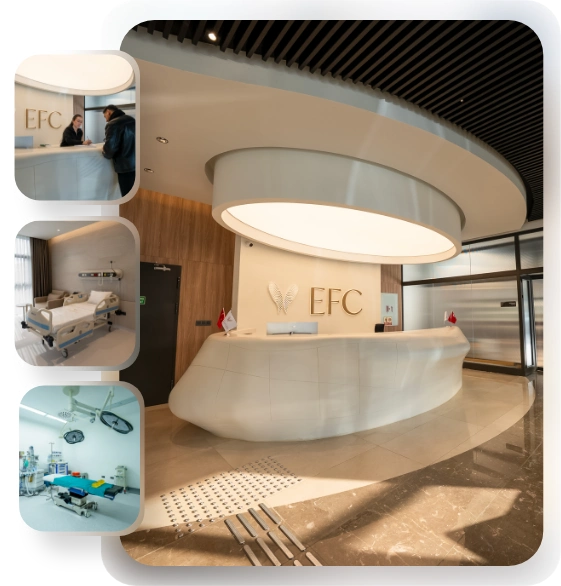
EFC CLINIC is a center of excellence specializing in the most meticulous fields of surgical medicine, from aesthetic surgery to interventional treatments—where every step progresses with refined attention. Medical excellence, aesthetic precision, and uncompromising ethical standards converge on the same path. Our subspecialty-trained experts aim to achieve natural and reliable results by delivering evidence-based care supported by modern imaging, standardized protocols, and safety systems. From consultation to recovery, your care is coordinated end-to-end with clear communication, transparent planning, and genuine respect for your health.
What is the concept of Almond Eye Aesthetics (Fox Eyes) and how does it change the gaze?
In recent years, expectations in aesthetic surgery have evolved beyond merely eliminating signs of aging toward giving the face a more characteristic and attractive form. Almond Eye Aesthetics, which we define in medical literature as “Lateral Canthal Elevation” and which is popularly known on social media and among the public as “Fox Eyes,” “Bella Eyes,” or “Cat Eyes,” is a procedure that responds to this modern demand.
The basic logic of this procedure is quite simple, but its application requires serious expertise. The lateral canthus, which is the outer corner of the eye, may be structurally positioned lower in some individuals or may descend over time due to gravity. This condition gives the person a sad, tired, and older-than-actual appearance. In an ideal aesthetic perception, it is desired that the outer corner of the eye be a few millimeters higher than the inner corner. With this operation, the outer corner is surgically moved slightly upward and outward. In this way, the eye gains that famous subtle slanted and almond shape. This form gives the person a more energetic, alert, and youthful expression. This is not just a temporary fashion trend but also an anatomical restoration. Because with gravity and aging, the corners of the eyes tend to descend; this surgery, in a sense, turns back the biological clock, counteracts gravity, and adds depth to the gaze.
Who constitutes the ideal candidate profile for Almond Eye Aesthetics and Temporal Lift?
As with any surgical intervention, proper patient selection is the most important key to success in this procedure as well. When evaluating our patients who come to us with this request, we look not only at the eye shape but at the entire facial anatomy. This operation can be preferred for both structural reasons and the effects of aging.
The situations in which this procedure can be applied are as follows:
- Genetically low eye corners
- Tired and sad facial expression
- Volume loss in the temple area
- Drooping of the outer eyebrow tail
- Eyelid sagging
- Asymmetrical eye structure
- Desire for a more attractive gaze
However, it is necessary to underline a very important detail here. This surgery is not suitable for every eye structure. Especially in individuals whose eye structure is anatomically very small or deep-set, meaning those with sunken eyes, pulling the eye outward may further narrow the eye opening and lead to a “squinted” appearance. Our aim is not to make the eye smaller but, on the contrary, to brighten the gaze while giving it an almond shape. Therefore, anatomical analysis is of vital importance.
Contact us now to get detailed information about our treatments and procedures and to schedule an appointment!
Why should Temporal Lift (Temple Lift) generally be performed together with this process?
One of the biggest mistakes in surgical planning is to think of the eye alone, as an organ independent of the rest of the face. The eye is a whole together with the temple (temporal region), eyebrow, and cheek, and it is in constant interaction with these neighboring structures. If the skin and muscle tissue in the temple area have sagged downward due to aging or structural reasons, lifting only the corner of the eye will not be sufficient. Because the heavy tissue resting on the eye, namely the eyebrow and temple skin, will overshadow the effect of the procedure in a short time.
Temporal Lift, or temple lifting, is the complementary and strengthening force that comes into play at exactly this point. This procedure lifts the drooping outer part of the eyebrow and the loosened tissue in the temple area upward. You can think of it like stretching a tent; when you lift the temple and eyebrow area that forms the roof of the tent, the eye underneath, which is like a window, emerges much more spacious and clearly. Temporal lift opens up the accumulations around the eyes and brings the eye-eyebrow distance to an ideal level. In this way, the success, permanence, and aesthetic appearance of almond eye aesthetics increase directly. Thanks to this integrated approach, the facial expression lifts as a whole and the result looks much more natural.
What are the differences between non-surgical thread lifting methods and Surgical Almond Eye Aesthetics?
Our patients rightfully often ask the question, “Why should I have surgery; isn’t thread lifting easier and more practical?” However, here it is necessary to clearly distinguish between the concepts of “ease” and “effectiveness and permanence.” Almond eye applications performed with threads are based on the principle of mechanically lifting the tissue upward by placing barbed threads under the skin. This procedure can be performed in an office setting and has a short recovery time, which may make it attractive.
However, non-surgical methods have significant disadvantages compared to surgery. The most fundamental difference is that the result is temporary. The threads used dissolve over time, and the tissue succumbs to gravity again. Generally, the lifespan of this effect is limited. In addition, as the threads under the skin loosen, asymmetries may occur or indentations may be seen along the line where the thread passes.
The surgical method, namely the combination of Temporal Lift and Canthopexy, is a structural change. In surgery, we do not just “hang” the tissue temporarily; we remove excess tissue and firmly fix the internal ligaments to the bone structure. The result obtained through surgery is permanent. Of course, aging continues, but your face ages while preserving its new and higher form. In other words, while thread lifting is like a temporary “makeup,” surgical intervention is a permanent “architectural restoration.” For patients seeking a permanent and definitive solution, surgery is always the gold standard.
What anatomical risks exist in surgical techniques and how is safety ensured?
Facial anatomy is quite complex, and this area contains delicate nerve structures that can be considered a “minefield” for surgeons. The safety of this surgery depends entirely on the surgeon’s knowledge of anatomy and experience. The most critical structure is the temporal branch of the facial nerve, which allows us to lift the eyebrows and wrinkle the forehead. This nerve runs superficially in the temple area, and its protection is of vital importance.
Possible risks are as follows:
- Temporary loss of sensation
- Edema
- Bruising
- Asymmetry
- Infection
- Scar-related problems
In interventions performed unconsciously or by hands not well-versed in anatomy, there is a risk of nerve damage. Therefore, this surgery must absolutely be performed by a specialist who is fully knowledgeable about facial anatomy, nerve pathways, and deep plane surgery. When the correct technique, such as subperiosteal or deep plane dissection, is used, the surgeon proceeds beneath the layer where the nerve is located, that is, through the safe zone. In this way, the risk of nerve damage is minimized. Safety begins with proper planning and meticulous surgical technique.
Contact us now to get detailed information about our treatments and procedures and to schedule an appointment!
What should be considered during the postoperative recovery process?
Temporal Lift and Almond Eye aesthetics are procedures with a relatively fast and comfortable recovery process compared to comprehensive facial lifting surgeries. The operation is usually performed under general anesthesia or sedation-assisted local anesthesia, which maximizes patient comfort. In the postoperative period, the patient’s compliance is an important factor that affects the quality of the result.
The points to be considered during the recovery period are as follows:
- Sleeping with the head elevated
- Cold compress
- Protection from the sun
- Use of prescribed medications
- Eye hygiene
- Allocating time for rest
In the first few days after the operation, it is completely normal to see swelling and mild bruising around the eyes and temples; this is the body’s natural healing response. Generally, the stitches are removed within 1 week. The return to social life is on average between 7 and 10 days. By the end of this period, bruising decreases to a level that can be concealed with makeup. However, it may take an average of 1–3 months for the tissues to settle and for the eye to take on its final almond shape in its clearest form.
How is naturalness preserved in the results of Almond Eye Aesthetics (Temporal Lift)?
The biggest fear of most patients is having an overly tense expression after surgery, as if they have “entered a wind tunnel,” or looking constantly surprised. This is a justified concern and is usually caused by surgical planning performed with incorrect vectors. For a natural result, the direction of pull, that is, the vector, is very important.
A purely vertical, upward pull lifts the eyebrows abnormally and gives the person a constantly surprised expression. A purely horizontal, outward pull overly narrows the eye and looks artificial. In successful surgery, the vector should be both upward and outward, that is, at an oblique angle. In addition, it is essential not to overstretch the tissues and to remain faithful to natural anatomical planes. Our goal is not to turn the patient into someone else but to reveal the best, most vibrant, and most attractive version of their own face. While lifting the tail of the eyebrow, preserving the natural position of the eyebrow head is one of the most important details that provides that soft yet effective gaze. Naturalness is achieved by avoiding exaggeration and preserving anatomical boundaries.
Blog Posts

Most Preferred Countries for Hair Transplantation
Among the most preferred countries for hair transplantation are Turkey, India, South Korea, and Poland. [...]
Read More
21
Jan
Jan

Hair Transplant Prices
Hair transplant prices vary depending on the technique to be used, the number of grafts, [...]
Read More
21
Jan
Jan
Most Preferred Countries for Plastic Surgery
Among the most preferred countries for plastic surgery, Turkey, South Korea, the United States, and [...]
Read More
21
Jan
Jan
Plastic Surgery Prices
Plastic surgery prices vary depending on the type of procedure, geographical location, the surgeon’s experience, [...]
Read More
21
Jan
Jan

Physical Therapy Prices
Physical therapy prices vary depending on the number of sessions to be applied, the treatment [...]
Read More
21
Jan
Jan

Dental Treatment Prices
Dental treatment prices vary depending on the type of procedure to be performed, the quality [...]
Read More
21
Jan
Jan

Most Preferred Countries for Dental Treatments
Among the most preferred countries for dental treatments are Turkey, Hungary, Mexico, and Thailand. These [...]
Read More
21
Jan
Jan