
 Türkçe
 Deutsch
 Français
Zygomatic implant treatment is an advanced surgical protocol applied in patients who no longer have sufficient bone volume in the upper jawbone to support standard implants, by gaining support from the cheekbone (zygoma). In severe maxillary atrophy cases where traditional methods and bone grafting procedures are insufficient, it aims to reach solid bone directly, saving the patient from long waiting periods. Even in fully edentulous jaws diagnosed as “implants cannot be placed,” this method is a definitive solution pathway that provides rapid, fixed, and aesthetic dental prosthetic rehabilitation by using existing anatomical structures.
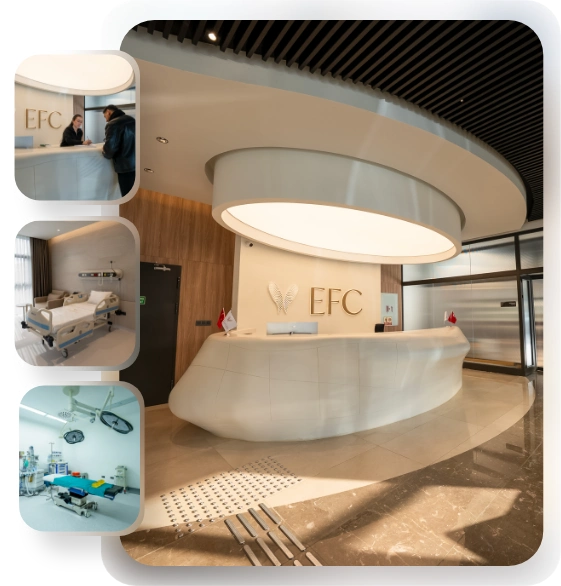
EFC CLINIC
Comprehensive Care: From Initial Consultation to Follow-Up.
EFC CLINIC is a center of excellence specializing in the most meticulous fields of surgical medicine, from aesthetic surgery to interventional treatments—where every step progresses with refined attention. Medical excellence, aesthetic precision, and uncompromising ethical standards converge on the same path. Our subspecialty-trained experts aim to achieve natural and reliable results by delivering evidence-based care supported by modern imaging, standardized protocols, and safety systems. From consultation to recovery, your care is coordinated end-to-end with clear communication, transparent planning, and genuine respect for your health.
What is a Zygomatic Implant and what is its main difference from standard implants?
We can compare standard dental implants to wall plugs used to hang a picture on a wall. For a wall plug to hold, the wall must be solid and thick. In the mouth, the situation is no different; for an implant to anchor, we need a jawbone of a certain thickness and height. However, in patients who have been edentulous for a long time, the upper jawbone gradually resorbs and disappears, almost like an iceberg melting away. In this case, we cannot find a foundation to place a standard implant.
Zygomatic implants, on the other hand, offer an engineering marvel of a solution. These implants are much longer than standard ones and have a special design. In this technique, we completely bypass the resorbed, weak jawbone. We fix the implant to the cheekbone (zygoma), one of the strongest structures of facial anatomy that does not resorb. In other words, instead of laying a foundation on weak ground, we extend the building’s foundations down to solid rock deep below. This method is an advanced surgical procedure that offers a second chance to patients without bone support.
Why is a Zygomatic Implant preferred instead of adding bone graft material?
In the past, “bone graft material” or “bone grafting” procedures were recommended for patients with resorbed bone. This process is quite arduous for patients and requires patience. For new bone to form, at least 6 months—sometimes 1 year—must be waited. Moreover, at the end of this waiting period, it is not always guaranteed whether the body will accept that bone or whether it will reach the desired hardness. The months-long wait can sometimes end in disappointment.
In zygomatic implantology, we eliminate these long waiting periods and uncertainties. The cheekbone is inherently very dense and hard. It always provides us with a ready, reliable anchorage point. In this way, we do not have to leave our patients toothless for months or wait for bone formation. By using the existing anatomy in the most efficient way, we dramatically shorten the treatment process. This speed and predictability are a major advantage, especially for patients who do not want to disconnect from their social life.
Who is this treatment and the Zygomatic Implant suitable for?
This method is not a routine procedure applied to everyone. It is a kind of “salvage” treatment for a specific patient group in which standard treatments are insufficient. It is generally ideal for our patients who have severe bone loss in the upper jaw and want fixed teeth.
We can list the patient groups for whom the treatment is suitable as follows:
- Those who have been fully edentulous for a long time
- Those with advanced bone resorption
- Those who have difficulty using removable dentures
- Those with weak bone structure due to genetic reasons
- Those who experienced tooth loss at an early age
- Individuals whose previous implant treatment has failed
- Patients who have lost jawbone due to trauma
- Individuals who have undergone tumor surgery
Contact us now to get detailed information about our treatments and procedures and to schedule an appointment!
How is Zygomatic Implant planning done before starting treatment?
In such a delicate surgery, there is absolutely no room for improvisation. The process begins with a very detailed radiological examination. When you come to our clinic, a 3D tomography scan is taken to create a digital twin of your facial and jaw structure. This tomography is our roadmap. We examine the volume of your cheekbone, the location of nerves, and the sinus cavities millimetrically.
Thanks to digital dentistry, we plan everything on a computer screen before entering surgery. The angle at which the implant will be placed, its length, and most importantly how the teeth to be made on top will look are determined in advance. Patients can even see the smile they will have at the end of the operation beforehand through digital simulations. This planning eliminates the risk of encountering surprises during surgery and maximizes the safety of the procedure.
Will there be pain during the operation and how long does Zygomatic Implant surgery take?
Our patients’ biggest concern is naturally pain. However, rest assured that these operations are performed with the highest level of patient comfort, generally under general anesthesia. That means while you are in a deep sleep, we carry out all procedures. You hear no sounds and feel no pain. When you wake up, the operation is finished.
When performed by an experienced surgical team, the operation time varies depending on the number of implants to be placed, but is approximately 2 hours on average. During this time, we place the implants in line with the digital plan we made beforehand. Mild swelling and bruising that may occur in the postoperative period are the body’s natural healing response and are brought under control within a few days with the medications we provide.
Will I be without teeth, what is Immediate Loading?
The biggest psychological and social advantage this system offers patients is that it eliminates the fear of being without teeth. The cheekbone is such a solid structure that we achieve a very high compression force (stability) the moment we place the implant. This solidity gives us the freedom to place teeth on the implants immediately.
We call this “Immediate Loading.” Within a very short time after surgery, usually within 24 hours, your fixed temporary teeth are placed. In other words, you come to the clinic with a removable denture or without teeth, but you return home in the evening with fixed teeth. These temporary teeth both restore your aesthetic appearance and allow you to regain your speaking function immediately. Your permanent porcelain teeth are made after waiting for full integration of the bone and the implant.
Contact us now to get detailed information about our treatments and procedures and to schedule an appointment!
What are the diet and nutrition rules for Zygomatic Implants during the healing process?
The first 3 months after surgery are the most critical turning point of the treatment. During this period, the implants integrate biologically with the bone (osseointegration). Even though your implants are very stable, they should not be subjected to excessive load during this integration process. Therefore, we ask our patients to strictly follow the “soft diet” rule for 3 months. Biting something hard can jeopardize the implant’s integration process with the bone.
Safe foods you can consume are as follows:
- Soups
- Purées
- Yogurt
- Pudding
- Boiled vegetables
- Omelet
- Well-cooked pasta
- Fish
- Ground meat dishes
- Smoothie varieties
Foods you should avoid are as follows:
- Nuts
- Hard fruits
- Bread crust
- Tough meats
- Sticky candies
- Ice
Is Zygomatic Implant care difficult in daily life?
Zygomatic implants and the prostheses on them have a different structure than your natural teeth. For this reason, their cleaning also requires a bit more care. The implant itself does not decay, that is true. However, the gums and tissues around the implant can become infected if not cleaned well. This is the biggest factor that shortens the life of the implant. We always tell our patients: “We made these teeth for you, but you are the one who will protect them.”
The tools you should use for maintenance are as follows:
- Oral irrigator
- Special interdental brushes
- Superfloss dental floss
- Soft toothbrush
- Toothpaste
- Mouthwash
Blog Posts

Most Preferred Countries for Hair Transplantation
Among the most preferred countries for hair transplantation are Turkey, India, South Korea, and Poland. [...]
Read More
21
Jan
Jan

Hair Transplant Prices
Hair transplant prices vary depending on the technique to be used, the number of grafts, [...]
Read More
21
Jan
Jan

Most Preferred Countries for Plastic Surgery
Among the most preferred countries for plastic surgery, Turkey, South Korea, the United States, and [...]
Read More
21
Jan
Jan

Plastic Surgery Prices
Plastic surgery prices vary depending on the type of procedure, geographical location, the surgeon’s experience, [...]
Read More
21
Jan
Jan

Physical Therapy Prices
Physical therapy prices vary depending on the number of sessions to be applied, the treatment [...]
Read More
21
Jan
Jan

Dental Treatment Prices
Dental treatment prices vary depending on the type of procedure to be performed, the quality [...]
Read More
21
Jan
Jan
Most Preferred Countries for Dental Treatments
Among the most preferred countries for dental treatments are Turkey, Hungary, Mexico, and Thailand. These [...]
Read More
21
Jan
Jan