
 Türkçe
 Deutsch
 Français
Full-mouth implant treatment is a fixed restoration solution that restores chewing ability, phonation, and aesthetic appearance in the closest form to natural teeth in cases where all teeth in the jaws are lost or existing teeth cannot be saved. This procedure is based on the principle of securing custom-designed zirconia or porcelain bridges onto titanium artificial roots strategically placed in the jawbone. This method completely eliminates retention problems and sore spots caused by removable complete dentures, and it also prevents jawbone resorption related to edentulism by stopping the collapse of the facial profile, offering patients a comfortable smile that will last a lifetime.
EFC CLINIC
Comprehensive Care: From Initial Consultation to Follow-Up.
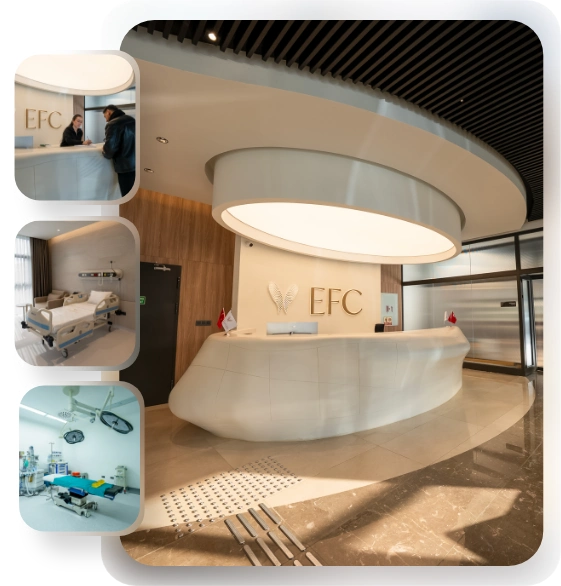
EFC CLINIC is a center of excellence specializing in the most meticulous fields of surgical medicine, from aesthetic surgery to interventional treatments—where every step progresses with refined attention. Medical excellence, aesthetic precision, and uncompromising ethical standards converge on the same path. Our subspecialty-trained experts aim to achieve natural and reliable results by delivering evidence-based care supported by modern imaging, standardized protocols, and safety systems. From consultation to recovery, your care is coordinated end-to-end with clear communication, transparent planning, and genuine respect for your health.
How Does the Process of the Implant Fusing with the Jawbone Work?
The most critical biological process underlying the treatment is the phenomenon called “osseointegration,” in which the implant integrates with the bone tissue at the cellular level. This process should not be considered like simple wound healing. In fact, it is the structural merging of the body’s living bone tissue with a tissue-friendly metal such as titanium into a single unit. The main reason titanium is preferred is that it is not perceived and rejected by the body as a foreign substance; on the contrary, bone cells grow by adhering tightly to the surface of this material.
For successful integration, several factors must come together. Chief among these is the tightness at the moment the implant is first placed, namely the initial retention strength we call “primary stability.” When the implant is surgically seated into the bone socket, it must be fixed with a certain compression force. This tightness ensures that the implant does not move even at a micro level during the healing period. If the implant moves during the healing phase, bone tissue cannot surround and encapsulate the implant, and the treatment may fail. In addition, roughening implant surfaces with special methods expands the area for bone cells to adhere to, accelerating this process.
How Does Digital Planning Make the Treatment Safer?
In full-mouth implant treatments, success depends not only on the surgeon’s manual skill but also on the detailed preoperative planning. Three-dimensional imaging techniques and artificial intelligence–assisted software have now replaced traditional radiographs. Thanks to these technologies, we can visualize the patient’s jawbone, nerve pathways, and sinus cavities with millimetric precision.
The greatest advantage of digital planning is that it makes the operation “surprise-free.” The angle, depth, and exact point of the jaw where the implant will be placed are determined in advance in a computer environment. Especially in cases where bone volume is borderline, placing the implant in the strongest region of the bone is vital. With this planning, the operation time is shortened, surgical trauma is reduced, and it is ensured that the prostheses to be placed on the implants are positioned in the most accurate location aesthetically.
What Are the Differences Between All-on-4 and All-on-6 Systems?
All-on-4 and All-on-6, which you often hear about in the treatment of complete edentulism, are treatment concepts that refer to the strategic placement of implants. Both systems aim to enable fixed teeth without the need for advanced bone augmentation procedures, especially in patients with posterior bone resorption. The main difference is the number of implants used and the biomechanical support principle.
In the All-on-4 system, a total of four implants are used per jaw. Two implants are placed straight in the anterior region, and two implants are placed angulated in the posterior region. The reason for angulating the posterior implants is to make maximum use of the existing bone without damaging anatomical structures such as nerve canals or sinus cavities. In the All-on-6 system, six implants are used. Increasing the number of implants allows chewing forces to be distributed more evenly to the jawbone. You can think of it like a six-legged table being more stable than a four-legged one. Which system is chosen depends entirely on the patient’s bone structure.
Some of the main advantages provided by these systems are as follows:
- Shorter treatment time
- Reduced need for bone grafting
- Lower cost
- The comfort of fixed teeth
- Improved aesthetic appearance
Contact us now to get detailed information about our treatments and procedures and to schedule an appointment!
Which Methods Are Applied When the Jawbone Is Insufficient?
It is quite natural to see resorption in the jawbone in individuals who have been edentulous for a long time. In cases where there is too much bone loss to place standard implants, bone augmentation, that is, bone grafting procedures, come into play. These procedures can be performed with pieces taken from the patient’s own bone or with reliable synthetic bone graft materials.
Some advanced surgical techniques applied in these cases are as follows:
- Sinus lifting
- Block bone grafting
- Bone expansion procedures
- Guided bone regeneration
- Distraction osteogenesis
It is important to know that these procedures extend the overall duration of treatment. A waiting period of 6 to 9 months may sometimes be required for the added bone to integrate with the body and harden. During this period, the patient generally uses removable temporary dentures.
Is It Possible to Get Teeth Immediately?
While the traditional method requires waiting for months for the implant to integrate with the bone, today the “Immediate Loading” protocol can be applied when suitable conditions are met. In this protocol, fixed temporary teeth are placed on the patient on the day the implants are inserted or within the following 24 hours. The biggest advantage of this method is that it eliminates the period of being without teeth and allows the patient to return to social life immediately.
However, for this method to be applicable, the implants must achieve very strong retention in the bone during surgery (a high torque value). If the bone is soft, the clinician may prefer to wait rather than take a risk. With immediately loaded teeth, hard foods should not be chewed, and only a soft diet should be followed.
Which Material Are the Permanent Teeth Made Of, and How Durable Are They?
After the healing process is completed, “Monolithic Zirconia” systems are the gold standard today for definitive prostheses. In the past, metal-supported porcelain was used, and separation of porcelain from the metal or fracture due to chewing forces (chipping) was a common problem.
Monolithic zirconia teeth are produced by milling a single solid block. There is no separate porcelain layer on top that can detach or fracture. In this way, very high durability is achieved without compromising aesthetics. In addition, zirconia is one of the most compatible materials with the gums and helps protect peri-implant health by reducing plaque accumulation.
Contact us now to get detailed information about our treatments and procedures and to schedule an appointment!
Who Is a Suitable Candidate for Implant Treatment, and Who Is at Risk?
Implants can be placed in almost everyone with good general health. However, some systemic conditions can impair healing and should be carefully evaluated before treatment. Knowing the risk factors is vital to preventing possible complications.
Conditions that may prevent treatment or require special precautions are as follows:
- Uncontrolled diabetes
- A recent heart attack
- Severe heart failure
- Presence of an active infection
- Ongoing radiotherapy
- Severe bleeding disorders
- Pregnancy
- Excessive smoking
Especially smoking is one of the most important factors that threaten implant success. Smoking disrupts blood flow in the tissues, delays healing, and increases the risk of infection.
How Should Post-Treatment Care and Hygiene Be?
For implants to remain in the mouth for a lifetime, it depends not only on surgical success but also on the patient’s careful maintenance. Although implants do not decay, the gums around them can become diseased. Therefore, oral hygiene should never be neglected.
For long-lasting use, the points to pay attention to are as follows:
- Regular tooth brushing
- Use of interdental brushes
- Use of dental floss
- Use of oral irrigators
- Six-month dental check-ups
- Avoiding smoking
- Avoiding hard-shelled foods
Blog Posts

Most Preferred Countries for Hair Transplantation
Among the most preferred countries for hair transplantation are Turkey, India, South Korea, and Poland. [...]
Read More
21
Jan
Jan

Hair Transplant Prices
Hair transplant prices vary depending on the technique to be used, the number of grafts, [...]
Read More
21
Jan
Jan

Most Preferred Countries for Plastic Surgery
Among the most preferred countries for plastic surgery, Turkey, South Korea, the United States, and [...]
Read More
21
Jan
Jan

Plastic Surgery Prices
Plastic surgery prices vary depending on the type of procedure, geographical location, the surgeon’s experience, [...]
Read More
21
Jan
Jan

Physical Therapy Prices
Physical therapy prices vary depending on the number of sessions to be applied, the treatment [...]
Read More
21
Jan
Jan

Dental Treatment Prices
Dental treatment prices vary depending on the type of procedure to be performed, the quality [...]
Read More
21
Jan
Jan
Most Preferred Countries for Dental Treatments
Among the most preferred countries for dental treatments are Turkey, Hungary, Mexico, and Thailand. These [...]
Read More
21
Jan
Jan