
 Türkçe
 Deutsch
 Français
Porcelain Laminate Veneers are aesthetic ceramic restorations with high light translucency, approximately 0.3 millimeters thin, applied to the front surfaces of teeth with special bonding techniques. Also known among the public as porcelain veneers, this treatment permanently resolves color, shape, and mild crowding problems with minimal reduction of healthy tooth structure or, in some cases, without any reduction at all. Thanks to their optical properties that precisely mimic natural tooth enamel, they offer a vivid and impressive smile design far from an artificial look. With their smooth, stain-resistant surface and superior biological compatibility, they are the strongest representative of the conservative approach in aesthetic dentistry.
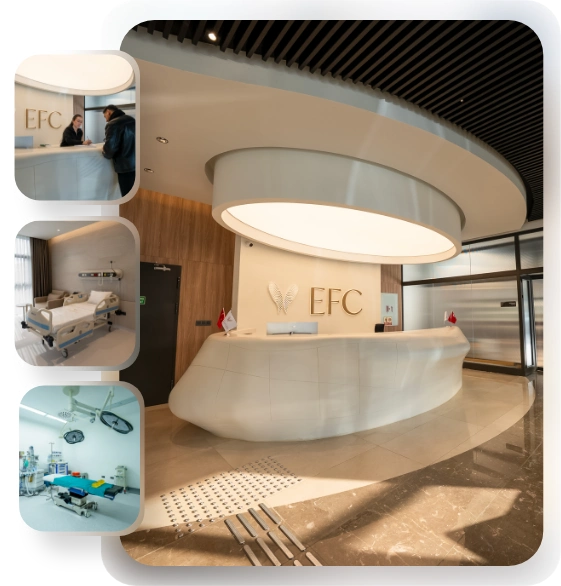
EFC CLINIC
Comprehensive Care: From Initial Consultation to Follow-Up.
EFC CLINIC is a center of excellence specializing in the most meticulous fields of surgical medicine, from aesthetic surgery to interventional treatments—where every step progresses with refined attention. Medical excellence, aesthetic precision, and uncompromising ethical standards converge on the same path. Our subspecialty-trained experts aim to achieve natural and reliable results by delivering evidence-based care supported by modern imaging, standardized protocols, and safety systems. From consultation to recovery, your care is coordinated end-to-end with clear communication, transparent planning, and genuine respect for your health.
How Do Porcelain Laminate Veneers Differ from Traditional Methods?
The biggest change in dentistry in recent years has been the adoption of the “conservative,” that is, tissue-preserving approach. Porcelain laminate veneers are the most successful representative of this philosophy. As can be understood from their name, which means “leaf” in Latin, these restorations are extremely delicate. While traditional porcelain or zirconia crowns require a significant amount of reduction from all sides of the tooth, laminate applications involve working only on the front surface of the tooth.
This distinction is clinically very critical because enamel, the outermost layer of the tooth, is the strongest and most valuable part for bonding procedures. In laminate treatment, our main goal is to keep this enamel tissue in place as much as possible. With advances in technology, porcelains as thin as 0.1 millimeters to 0.3 millimeters, almost the thickness of a contact lens, can now be produced. In this way, the form, color, and position of the tooth can be completely changed with minimal intervention. The biggest difference compared to traditional crowns is that the original tissue on the back and inner structure of the tooth is completely preserved. This allows the tooth to maintain its vitality and structural integrity for many years.
In Which Situations Are Porcelain Laminate Veneers Applied?
This treatment method not only addresses aesthetic concerns but also corrects certain functional and structural issues. Because problems experienced especially in the anterior teeth directly affect a person’s smile aesthetics, laminate applications are frequently preferred in this area. As dentists, when evaluating our patients, we consider specific situations in which this treatment is suitable.
The situations in which porcelain laminate veneers are commonly applied are as follows:
- Permanent discolorations
- Spaced teeth
- Chipped tooth edges
- Worn tooth surfaces
- Mild crowding
- Short tooth lengths
- Old and discolored fillings
- Shape deformities on the tooth surface
Why Should Porcelain Laminate Material Be Preferred?
Porcelain is the material used in dentistry that has optical properties closest to natural tooth enamel. The main reason for this is its ability to reflect and transmit light. Our natural teeth do not behave like a matte wall when light falls on them; they absorb part of the light and reflect it. Porcelain laminate veneers exhibit the same behavior. In this way, instead of artificial-looking, opaque, and dull white teeth, a lively appearance with depth that integrates with your face is achieved.
As important as the aesthetic aspect is, the biological aspect is also vital. Porcelain is a “biocompatible” material. This term means that the body and tissues do not perceive this material as a foreign substance; on the contrary, they adapt to it. Especially in terms of gum health, porcelain is an excellent option. Conditions such as purple discoloration along the gum margin or redness and swelling of the gums, which were frequently seen in old-type metal-supported crowns, are not observed in properly applied porcelain laminates. Because the surface of porcelain is as smooth as glass, it is very difficult for bacterial plaque to adhere. This feature helps the gums remain pink, healthy, and firm.
Contact us now to get detailed information about our treatments and procedures and to schedule an appointment!
What Is the Difference Between Porcelain Laminates and Composite Fillings?
One of the issues our patients are most curious about is the longevity of the procedure and whether it will change color over time. Here, the difference between porcelain laminates and composite bonding procedures becomes clear. Composite materials are resin-based by nature and have a microscopically porous structure. For this reason, they may change color over time with staining foods. Just like your natural teeth, they can yellow and become dull.
However, porcelain laminate veneers have an inorganic glass-ceramic structure. Their surfaces are extremely hard, smooth, and polished. Thanks to these properties, they show complete resistance to extrinsic stains. The whiteness and brightness on the first day of treatment remain the same even years later. Porcelain does not absorb liquids over time and does not trap color pigments inside. For individuals with high aesthetic expectations and who worry about their teeth yellowing in the future, this color stability offered by porcelain makes it an unrivaled option.
What Conditions Prevent Porcelain Laminate Treatment?
Although porcelain laminate veneers offer remarkable solutions, not every patient may be a suitable candidate for this treatment. The foundation of clinical success is correct patient selection and risk management. In some cases, laminate application may be risky, or changes may be required in the treatment protocol. In such cases, it is necessary to analyze the patient’s oral structure and habits in detail.
Conditions that should be considered during the treatment process or that may constitute an obstacle are as follows:
- Teeth grinding habit
- Teeth clenching
- Nail-biting habit
- Pen-biting habit
- Insufficient enamel tissue
- Advanced periodontal diseases
- Severe tooth crowding
- High risk of caries
- Edge-to-edge bite relationship
Treatment is not impossible in patients with these risk factors, but additional precautions are essential. For example, in patients who clench their teeth, using a night guard is not an option but a necessity to extend the lifespan of the treatment.
How Do the Treatment Process and Digital Design Progress?
The treatment process has become quite predictable and comfortable with the opportunities offered by technology. The process usually begins with a detailed analysis and smile design. Based on the photographs and digital impressions taken in the first session, the tooth form most suitable for the person’s facial line is designed. The most exciting part is the try-in stage. Without touching the teeth at all, a plastic copy of the designed teeth is applied in the mouth. The person sees in the mirror, live, how they will look at the end of treatment and tests their speech and smile.
After the design is approved, a very thin preparation is performed under local anesthesia. A microscopic layer of enamel is removed only from the front surface of the tooth. Then, using precise digital impression methods, the copy of the teeth is transferred into the computer environment. Porcelain shells are produced in the laboratory with micron-level precision. This process usually takes about a week. After try-ins, the laminates are permanently bonded to the tooth surface. Provided that gum contouring is not required, the entire treatment is usually completed in a few sessions.
Contact us now to get detailed information about our treatments and procedures and to schedule an appointment!
Why Is the Bonding Procedure for Porcelain Laminates Critical?
The success of porcelain laminates depends not only on the quality of the porcelain but also on the perfection of the bonding technique called “adhesive cementation.” This is not an ordinary bonding; it is the process in which the tooth and porcelain become a single body chemically and physically. The technical precision shown at this stage is the most important factor that determines the lifespan of the laminates.
During the procedure, the inner surface of the porcelain is treated with special acids and bonding agents. The tooth surface is prepared in a similar way at the same time. The special adhesives used are light-cured materials. When applied correctly, porcelain laminates adhere so strongly to tooth enamel that separating them from the tooth becomes almost impossible. In addition, the shade and thickness of the adhesive material directly affect the final color and vitality of the porcelain.
What Should Be Considered After Porcelain Laminates?
The first days after the treatment is completed are very important in terms of the adaptation process. A certain period of time is needed for the bonding to fully cure and for color stability to settle. During this period, our patients need to pay special attention to their dietary habits. Some restrictions we recommend as dentists ensure that the treatment remains long-lasting.
The foods to be avoided especially within the first 48 hours immediately after treatment are as follows:
- Tea
- Coffee
- Red wine
- Tomato paste–based sauces
- Sour cherry juice
- Beetroot
- Curry dishes
- Soy sauce
In long-term care, the rules that apply to your natural teeth also apply to laminates. Traumatic actions such as cracking hard-shelled foods with the teeth or trying to open a bottle cap can damage porcelain laminates just as they can fracture a natural tooth. Therefore, the front teeth should not be used like a tool. Daily oral hygiene practices such as tooth brushing and flossing must never be neglected. If gum health deteriorates, the lifespan of the restorations is also jeopardized. When marginal adaptation is monitored through regular dental check-ups, porcelain laminate veneers will continue to adorn your smile with their first-day sparkle for years.
Blog Posts

Most Preferred Countries for Hair Transplantation
Among the most preferred countries for hair transplantation are Turkey, India, South Korea, and Poland. [...]
Read More
21
Jan
Jan

Hair Transplant Prices
Hair transplant prices vary depending on the technique to be used, the number of grafts, [...]
Read More
21
Jan
Jan
Most Preferred Countries for Plastic Surgery
Among the most preferred countries for plastic surgery, Turkey, South Korea, the United States, and [...]
Read More
21
Jan
Jan
Plastic Surgery Prices
Plastic surgery prices vary depending on the type of procedure, geographical location, the surgeon’s experience, [...]
Read More
21
Jan
Jan

Physical Therapy Prices
Physical therapy prices vary depending on the number of sessions to be applied, the treatment [...]
Read More
21
Jan
Jan
Dental Treatment Prices
Dental treatment prices vary depending on the type of procedure to be performed, the quality [...]
Read More
21
Jan
Jan
Most Preferred Countries for Dental Treatments
Among the most preferred countries for dental treatments are Turkey, Hungary, Mexico, and Thailand. These [...]
Read More
21
Jan
Jan