
 Türkçe
 Deutsch
 Français
Crown treatment is a fixed prosthetic dental method in which teeth that have suffered excessive loss of structure, have shape deformities, or are discolored are restored by being completely covered with special materials produced in the natural tooth form. Advanced prosthetic approaches applied in modern dentistry not only protect the damaged tooth; thanks to highly biocompatible all-ceramic systems such as zirconia and Emax, they fully restore chewing function while precisely replicating the aesthetic appearance of natural tooth enamel. Aimed at preserving the integrity of tooth structure and the health of surrounding tissues in the long term, these restorations are the most permanent solution, combining functional chewing ability with ideal smile aesthetics.
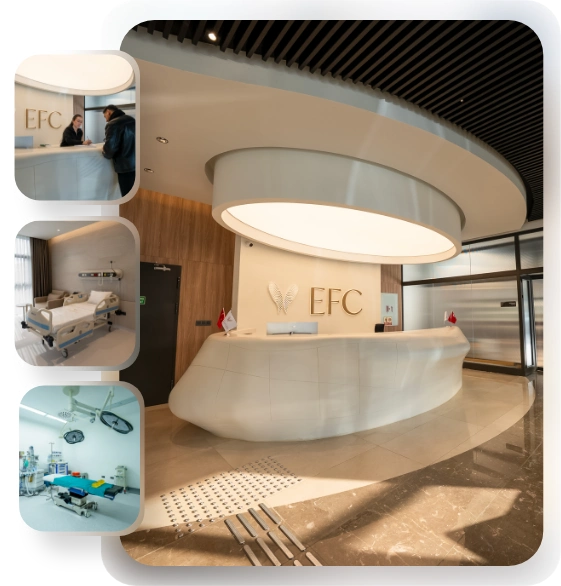
EFC CLINIC
Comprehensive Care: From Initial Consultation to Follow-Up.
EFC CLINIC is a center of excellence specializing in the most meticulous fields of surgical medicine, from aesthetic surgery to interventional treatments—where every step progresses with refined attention. Medical excellence, aesthetic precision, and uncompromising ethical standards converge on the same path. Our subspecialty-trained experts aim to achieve natural and reliable results by delivering evidence-based care supported by modern imaging, standardized protocols, and safety systems. From consultation to recovery, your care is coordinated end-to-end with clear communication, transparent planning, and genuine respect for your health.
What Is the Difference Between a Crown and a Veneer?
The terms used in dental treatments can sometimes be confusing. However, the basic logic is actually based on a fairly simple distinction. Traditional crowns are structures that protect the tooth by covering it from all sides like a hat. The tooth is reduced by removing a certain amount of material from all surfaces, and a full protective covering is placed on it.
In contrast, modern dentistry adopts the principle of preserving tissue to the maximum extent. This is exactly where veneer restorations come into play. A veneer, instead of cutting the entire tooth, consists of very thin porcelain shells, about the thickness of a fingernail, applied only to the front surface. In this method, intervention to tooth structure is at a minimum level. The more the natural structure of the tooth is preserved, the better the long-term health of the tooth. Which method is chosen is determined by how much structure the tooth has lost and the extent of the aesthetic need.
Why Are All-Ceramic Systems Preferred Over Metal-Supported Crowns?
In the past, the first option that came to mind when getting a dental crown was porcelain with a gray metal substructure. Although these metals provided durability, they seriously overshadowed aesthetics. Metal is a material that does not transmit light. A natural tooth, on the other hand, has a translucent structure that absorbs and reflects light. Because metal-supported crowns block light translucency, no matter how much effort is made, they can appear matte and dull under certain lighting. In addition, when gum recession occurs over time, that thin gray line appearing at the base of the tooth was one of the biggest problems that disrupted aesthetic perception.
Today, all-ceramic systems have eliminated these problems. These materials, which do not contain metal, transmit light like a natural tooth. In this way, the vivid and natural appearance coming from the depth of the tooth can be replicated exactly. In addition to their aesthetic advantages, their biological compatibility is also excellent. They eliminate the risk of metal allergy and exhibit perfect harmony with the gums.
In Which Situations Is a Zirconia Crown Ideal?
Zirconia is the first material that comes to mind in dentistry when strength and durability are mentioned. Thanks to its dense crystalline content, it shows incredible resistance against chewing forces. Especially in posterior teeth, where chewing pressure is very high, zirconia is the most reliable safe harbor.
Although this material is not as assertive as glass ceramics in terms of light translucency, it is much more aesthetic than metal-supported porcelains. However, it draws its main strength from its mechanical durability. In long bridges, that is, in cases where multiple teeth are missing, zirconia is preferred so that the pontic can carry the load without fracturing.
The main situations in which zirconia is used are as follows:
- Posterior teeth
- Long dental bridges
- Implant-supported prostheses
- Dark-colored teeth
- Areas with a high risk of fracture
Contact us now to get detailed information about our treatments and procedures and to schedule an appointment!
Why Does an Emax Crown Stand Out in Anterior Aesthetics?
If our patient’s expectation is “no one should realize I had dental work done,” our strongest asset is Emax, that is, lithium disilicate glass ceramics. This material contains less crystal than zirconia and has a much more glassy structure. Therefore, it transmits, reflects, and refracts light perfectly. It is the material closest to the translucency of natural tooth enamel.
Especially in anterior incisors, in smile design, and in cases where aesthetic expectation is at its peak, Emax is unrivaled. Thanks to its surface properties, it does not stain and maintains its first-day brightness for many years. However, there is a price for this high aesthetics; its mechanical strength is not as high as zirconia. Therefore, it is generally preferred in single-tooth crowns or very short bridges. Its use is more limited in posterior regions or long spans due to the risk of fracture.
According to Which Criteria Does the Dentist Determine the Material Selection?
When a patient comes to the clinic, they may have a particular material name in mind. However, correct treatment is shaped not only by the patient’s request but by clinical realities. The decision-making process requires establishing a delicate balance between aesthetics and durability. As dentists, we evaluate each case on its own.
The criteria considered in this evaluation process are as follows:
- The tooth’s position in the mouth
- The patient’s bite pattern
- The magnitude of chewing forces
- The level of aesthetic expectation
- The condition of the opposing tooth
- The length of edentulous spaces
- Parafunctional habits
- Gingival biotype
- Existing tooth shade
- Allergy history
For example, in patients who have an allergy to metal or have a sensitive constitution, all-ceramic systems (Zirconia or Emax) are biologically the safest option.
How Is Crown Treatment Planned in Patients with Bruxism?
Clenching or grinding (bruxism) is one of the greatest enemies of restorative treatments. In bruxism patients, the jaw muscles produce pressure many times greater than the chewing force applied by a normal person. This uncontrolled force not only wears down natural teeth but can also crack or fracture porcelain crowns.
In such cases, aesthetic concerns should give way to the priority of “sustainability.” In a patient diagnosed with bruxism, although Emax may look very appealing aesthetically, it may not be the right choice due to the risk of fracture. At this point, the mechanically much stronger zirconia material comes into play. The structure of zirconia can absorb these heavy loads. In addition, protective measures such as using a night guard after treatment are also an integral part of the process.
Contact us now to get detailed information about our treatments and procedures and to schedule an appointment!
How Does the Tooth Reduction and Preparation Process Progress?
The preparation stage, popularly known as tooth reduction, is actually the foundation of the entire treatment. The dentist’s precision at this stage directly determines the lifespan of the crown. The goal is to create an area on the tooth where the crown will fit perfectly.
Points to consider during preparation are as follows:
- Preserving the vitality of the tooth
- Ensuring sufficient retention
- Defining the gumline margin
- Creating a smooth surface
- Adequate material thickness
Especially the border line where the crown meets the tooth, which we call “marginal integrity,” is of vital importance. If this line is not compatible at a microscopic level, bacterial leakage occurs from that gap over time, and the tooth under the crown begins to decay.
Why Is a Temporary Crown Necessary During Treatment?
Processes in modern dentistry have accelerated considerably. However, it is out of the question to leave the patient without teeth during the few days while the permanent crowns are prepared in the laboratory. Immediately after the teeth are prepared, temporary crowns customized for the patient are placed.
The functions of these temporary teeth are as follows:
- Preventing tooth sensitivity
- Maintaining aesthetic appearance
- Sustaining chewing function
- Shaping the gums
- Preventing tooth movement
Temporary teeth ensure that the gums remain healthy until the permanent prosthesis arrives. Healthy and pink gums are the most critical factor for the success of the final cementation procedure.
What Factors Affect the Success and Lifespan of Crowns?
How long crowns will last is the question our patients ask most frequently. The success of a prosthesis does not depend on a single person or a single material. This is teamwork, and every link of the chain must be strong.
The main factors affecting success are as follows:
- Correct diagnosis
- Precise tooth preparation
- High-quality impression taking
- Laboratory workmanship
- Quality of the materials used
- Precise cementation procedure
- Regular tooth brushing
- Flossing
- Periodic dental check-ups
- Balanced dietary habits
Especially the cementation stage is very critical. Cementations performed while the gums are bleeding or swollen cause problems in the long term. Cementation performed by waiting for biological healing and under proper isolation ensures that the crown integrates with the tooth and remains in the mouth for many years. As a result, no matter how good high-technology materials are, the care the patient shows for oral hygiene is the most important factor that determines the real lifespan of the treatment.
Blog Posts

Most Preferred Countries for Hair Transplantation
Among the most preferred countries for hair transplantation are Turkey, India, South Korea, and Poland. [...]
Read More
21
Jan
Jan
Hair Transplant Prices
Hair transplant prices vary depending on the technique to be used, the number of grafts, [...]
Read More
21
Jan
Jan
Most Preferred Countries for Plastic Surgery
Among the most preferred countries for plastic surgery, Turkey, South Korea, the United States, and [...]
Read More
21
Jan
Jan
Plastic Surgery Prices
Plastic surgery prices vary depending on the type of procedure, geographical location, the surgeon’s experience, [...]
Read More
21
Jan
Jan

Physical Therapy Prices
Physical therapy prices vary depending on the number of sessions to be applied, the treatment [...]
Read More
21
Jan
Jan

Dental Treatment Prices
Dental treatment prices vary depending on the type of procedure to be performed, the quality [...]
Read More
21
Jan
Jan
Most Preferred Countries for Dental Treatments
Among the most preferred countries for dental treatments are Turkey, Hungary, Mexico, and Thailand. These [...]
Read More
21
Jan
Jan