
 Türkçe
 Deutsch
 Français
Cosmetic dentistry is a multidisciplinary treatment discipline that is based on preserving chewing function and gum health while creating an aesthetic smile integrated with a person’s facial anatomy, lip structure, and character traits. This comprehensive approach not only improves the color or form of the teeth but also delivers long-lasting and natural results by using digital smile design technology, minimally invasive porcelain veneers, and biocompatible zirconium materials. Modern treatment protocols that combine aesthetic expectations with biomechanical rules restructure every detail, from the gums to tooth alignment, in perfect harmony.
EFC CLINIC
Comprehensive Care: From Initial Consultation to Follow-Up.
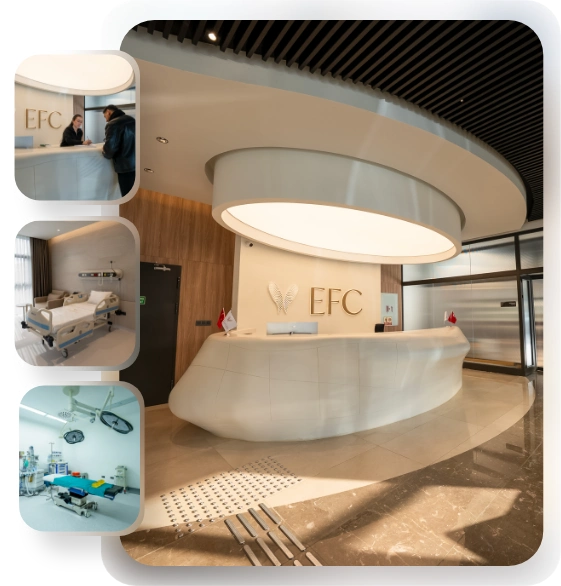
EFC CLINIC is a center of excellence specializing in the most meticulous fields of surgical medicine, from aesthetic surgery to interventional treatments—where every step progresses with refined attention. Medical excellence, aesthetic precision, and uncompromising ethical standards converge on the same path. Our subspecialty-trained experts aim to achieve natural and reliable results by delivering evidence-based care supported by modern imaging, standardized protocols, and safety systems. From consultation to recovery, your care is coordinated end-to-end with clear communication, transparent planning, and genuine respect for your health.
What Do Cosmetic Dentistry Applications Include?
When cosmetic dentistry is mentioned, the first thing that usually comes to mind is sparkling white teeth, but the scope of this field is much broader. The main goal is to achieve the most suitable form, color, and alignment for the person’s facial anatomy. In this process, it is not sufficient for the teeth to be improved only visually; chewing function must work flawlessly, and sounds must be produced correctly during speech.
Treatment protocols include the following elements, shaped according to the person’s needs:
- Tooth color adjustments
- Tooth form changes
- Tooth alignment corrections
- Gum symmetry
- Lip support
- Facial aesthetic harmony
While performing all these procedures, it should not be forgotten that the materials placed inside the mouth are inanimate structures. Therefore, selecting materials that prevent bacterial adhesion at the points where they meet the gums, do not cause allergic reactions, and have physical properties similar to natural tooth enamel is of vital importance.
How Does Digital Smile Design (DSD) Show the Treatment Result?
Our patients’ biggest concern is usually the question, “What will my teeth look like at the end of the treatment?” In traditional methods, the answer to this question could only be seen after the procedures were completed, and it was difficult to reverse. However, digital dentistry has completely eliminated this uncertainty. Digital Smile Design is a revolutionary communication tool that allows you to experience the result exactly before starting the treatment.
The process begins with detailed photographs and videos. A digital map of your face is created. With analyses performed on these data, the tooth form most suitable for your facial expressions and proportions is designed in a virtual environment. However, the most exciting part is the trial stage we call “Mock-up.” A plastic model of the designed smile is produced and applied in your mouth without any procedures on your teeth yet (without cutting or reduction).
When you look in the mirror, you see the smile you will have when the treatment is finished, live on your own face. At this stage, we can lengthen the teeth, round the corners, or change the form. No permanent procedure is started without your approval. This transparent process both helps you feel secure and elevates communication between dentist and patient to the highest level.
Contact us now to get detailed information about our treatments and procedures and to schedule an appointment!
Which Problems Do Porcelain Laminate (Veneer) Teeth Solve?
Porcelain laminates, considered the star of aesthetic dentistry, are one of the most respectful approaches to tooth structure. These very thin porcelains, about the thickness of a false fingernail (approximately 0.3 – 0.7 mm), are bonded only to the front surface of the tooth. Thanks to their very high light translucency, they replicate exactly the depth and vitality of natural tooth enamel. Extremely natural results are obtained, far from a matte or artificial appearance.
This method is an ideal solution especially in the following situations:
- Spaces between teeth (Diastema)
- Mild crowding
- Permanent discolorations
- Chipped tooth edges
- Worn tooth surfaces
- Shape deformities
The greatest advantage of laminates is that they are resistant to staining. External factors such as tea, coffee, or smoking do not cause color change thanks to the glassy structure of the porcelain surface. It promises a smile that retains its first-day brightness even after years.
How Does the Tooth Reduction and Preparation Process Work?
“Will my teeth be cut a lot?” is the most important question on the mind of anyone considering aesthetic treatment. In modern dentistry, the “minimally invasive” principle applies. That is, we aim to achieve maximum aesthetics without touching healthy tooth structure or by touching it at a minimal level. In laminate applications, the amount of tissue removed from the tooth surface is about half a millimeter. In some suitable cases, it is possible to apply directly without any reduction (prepless).
The bonding technologies used (adhesion) ensure that the laminates chemically integrate with the tooth. The tooth and porcelain act almost like a single piece. The technical detail that must be considered here is the thickness of the porcelain and the choice of cement. For restorations thinner than 0.7 mm, special light-cured cements are used. These materials do not change color over time and provide very strong retention. Working with microscopic precision in the preparation stage ensures that the junction line between the tooth and porcelain is smooth enough to be imperceptible; this is critical for gum health.
Why Is Zirconium Dental Crowning Preferred?
If tooth structure loss is very extensive or if resistance against chewing forces is required in posterior regions, zirconium crowns are preferred instead of laminates. Unlike old-type metal-supported porcelains, zirconium is a white alloy. Since it does not contain metal, it does not create a gray reflection at the gumline or cause discoloration.
The main advantages offered by zirconium are as follows:
- High fracture resistance
- Biological compatibility
- Thermal insulation
- Natural appearance
- Tissue-friendly surface
Zirconium achieves excellent compatibility with the gums. The body does not perceive this material as a foreign object, thereby minimizing the risk of gum recession or allergic reactions. Its safe usability even in posterior teeth allows us to provide both aesthetics and function at the same time.
Contact us now to get detailed information about our treatments and procedures and to schedule an appointment!
What Is the Difference Between Bonding and Porcelain?
Composite bonding is a practical method used to correct minor imperfections in teeth. Unlike porcelain laminates, it does not require a laboratory phase and is usually applied chairside by the dentist in a single session. Tooth-colored filling materials are artistically added to the tooth and shaped.
However, there are serious durability differences between bonding and porcelain. Bonding material may show the following changes over time:
- Color change
- Surface dulling
- Marginal staining
- Easier wear
While porcelain laminates maintain their aesthetic properties for 10–15 years and beyond, the lifespan of bonding procedures is generally between 3 and 5 years and may require polishing or repair during this period. Although bonding is a more economical and faster solution, porcelain systems are always superior for those seeking long-term permanence and unchanged aesthetics.
Why Is Pink Aesthetics (Gum Aesthetics) Important?
Think of a painting; no matter how beautiful the image is, if the frame is crooked or damaged, the artwork cannot show itself. In dentistry, teeth are the image and gums are the frame. Focusing only on white teeth is not sufficient for an aesthetic smile. The gums need to be healthy, symmetrical, and at the correct level.
The situations corrected with pink aesthetics applications are as follows:
- Gummy Smile (gum smile)
- Gum recession
- Level irregularities
- Gum pigmentation
- Short tooth appearance
In cases where the gums are excessively visible when smiling, the gum level is raised with simple laser procedures or small surgical touches. This lengthens the teeth and balances the smile line. The procedures are generally painless, and the healing process is quite fast.
Does Tooth Whitening Damage Teeth?
One of the most frequently wondered topics in society is the safety of whitening (bleaching). Whitening procedures performed under professional supervision do not damage tooth enamel. Without disrupting the structure of the tooth, they only remove color pigments accumulated in the pores.
Two main methods are applied: in-office and at-home. While in-office provides fast results in a single session at the clinic, at-home takes a few weeks with custom-made trays. However, uncontrolled products sold in markets or “natural” recipes seen on the internet can be risky.
The risks of unconscious applications are as follows:
- Permanent tooth sensitivity
- Enamel abrasion
- Gum burns
- Color fluctuations
Therefore, whitening must be performed after a dentist examination, by selecting agents suitable for the individual.
Blog Posts

Most Preferred Countries for Hair Transplantation
Among the most preferred countries for hair transplantation are Turkey, India, South Korea, and Poland. [...]
Read More
21
Jan
Jan

Hair Transplant Prices
Hair transplant prices vary depending on the technique to be used, the number of grafts, [...]
Read More
21
Jan
Jan
Most Preferred Countries for Plastic Surgery
Among the most preferred countries for plastic surgery, Turkey, South Korea, the United States, and [...]
Read More
21
Jan
Jan
Plastic Surgery Prices
Plastic surgery prices vary depending on the type of procedure, geographical location, the surgeon’s experience, [...]
Read More
21
Jan
Jan
Physical Therapy Prices
Physical therapy prices vary depending on the number of sessions to be applied, the treatment [...]
Read More
21
Jan
Jan
Dental Treatment Prices
Dental treatment prices vary depending on the type of procedure to be performed, the quality [...]
Read More
21
Jan
Jan
Most Preferred Countries for Dental Treatments
Among the most preferred countries for dental treatments are Turkey, Hungary, Mexico, and Thailand. These [...]
Read More
21
Jan
Jan