
 Türkçe
 Deutsch
 Français
Dental implant treatment is the application of an artificial tooth root, usually made of titanium or zirconium, surgically placed into the jawbone in order to eliminate the functional and aesthetic loss caused by missing teeth. This method is a biological rehabilitation process that stops jawbone resorption caused by tooth loss and best mimics the natural tooth structure. Unlike traditional bridges, dental implants do not require cutting adjacent healthy teeth, and thanks to fixed porcelain or zirconium prostheses placed on them, they permanently restore chewing comfort, speech clarity, and facial aesthetics. This treatment, applied in modern dentistry, is the longest-lasting and most reliable solution that holistically protects oral health.
EFC CLINIC
Comprehensive Care: From Initial Consultation to Follow-Up.
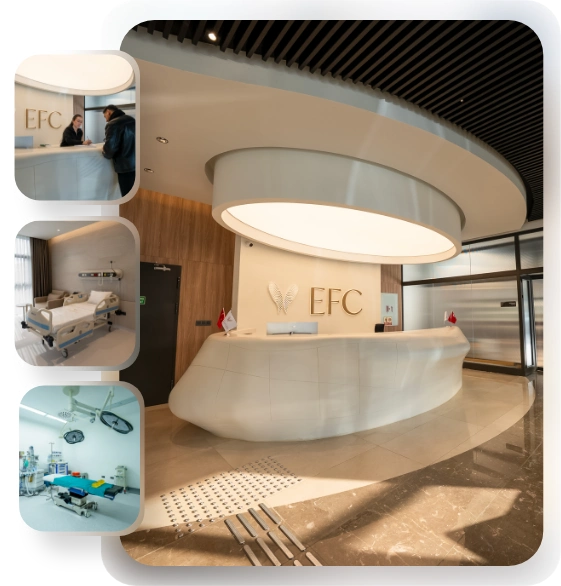
EFC CLINIC is a center of excellence specializing in the most meticulous fields of surgical medicine, from aesthetic surgery to interventional treatments—where every step progresses with refined attention. Medical excellence, aesthetic precision, and uncompromising ethical standards converge on the same path. Our subspecialty-trained experts aim to achieve natural and reliable results by delivering evidence-based care supported by modern imaging, standardized protocols, and safety systems. From consultation to recovery, your care is coordinated end-to-end with clear communication, transparent planning, and genuine respect for your health.
What is dental implant treatment and how does its basic logic work?
Implant treatment, commonly known as a “screw-in tooth,” is actually the art of mimicking nature. When the root of a lost tooth is no longer there, the jawbone begins to recede, thinking it has become functionless. In implant treatment, artificial roots made of titanium or zirconium, which are perfectly compatible with the tissue, are placed into the jawbone.
This procedure is very different from traditional bridge prostheses. While making a bridge requires cutting the healthy teeth on the sides to fill the gap, implant treatment does not touch the neighboring teeth. Only the area of the missing tooth is treated. This artificial root forms a biological bond with the bone. After this bond is established, a tooth prosthesis made of porcelain or zirconium is placed on top. As a result, an aesthetic and strong structure is obtained that gives the feeling of eating with your own tooth.
Who is a suitable candidate for implant treatment?
Implant treatment can be applied to almost any individual who has completed growth and development and whose general health condition is suitable. While treatment used to be considered impossible in patients with bone loss, today this situation has largely been overcome with advanced surgical techniques. However, for an ideal treatment process, certain criteria still need to be met.
The basic criteria sought for eligibility are as follows:
- Being over 18 years old
- Sufficient bone volume
- Healthy gum tissue
- A good oral hygiene habit
- A controlled general health condition
Your dentist will examine your jaw structure with a detailed clinical examination and three-dimensional tomography images and will clearly determine whether your bone quality is suitable for an implant.
Is brand and material important in implant selection?
One of the issues that confuses patients the most is implant brand and material selection. There are hundreds of different brands on the market. What matters here is how established the brand is, whether it is supported by scientific research, and the availability of parts in the future if a component is needed. When it comes to your health, proven global brands or high-standard domestic productions should be preferred.
In terms of material, two main options stand out: Titanium and Zirconium. Titanium is a metal that has been used for many years, has excellent compatibility with bone, and is highly resistant to fracture. Zirconium implants, on the other hand, are white, metal-free implants preferred more in individuals with metal allergies or in anterior aesthetic areas where the gum is thin. Both materials are biologically fully compatible with the body.
Contact us now to get detailed information about our treatments and procedures and to schedule an appointment!
How do smoking and systemic diseases affect implant success?
Although implant surgery is a simple procedure, it requires the body’s healing potential. Some habits and diseases can negatively affect this healing process. In particular, smoking is one of the most important factors that threaten implant success. Smoking disrupts blood circulation in the gums, preventing the area from being nourished and increasing the risk of infection. Therefore, it is strongly recommended to stop smoking in the pre- and post-surgical period.
Systemic conditions such as diabetes (blood sugar disease) also affect the process. However, the presence of diabetes is not an obstacle to implant placement; what matters is that the disease is under control. Implant treatment can be safely applied in patients whose blood sugar levels are stable.
Situations that constitute risk factors are as follows:
- Heavy smoking
- Uncontrolled diabetes
- Radiotherapy to the head and neck region
- Use of medications for bone loss
- Diseases that suppress the immune system
How long does it take for the implant to fuse with the bone?
After the implant is placed, the process of integration of the implant with the bone, called “osseointegration,” begins. This process is a biological waiting period that must be completed before the implant is loaded. The duration varies depending on the person’s bone structure, age, and the region where the implant is placed.
The lower jawbone is structurally harder and denser. Therefore, healing in the lower jaw generally occurs faster and takes an average of 2 to 3 months. The upper jawbone has a softer and more porous structure, so it is usually necessary to wait 3 to 4 months for the implant to fully integrate. If additional surgical procedures such as bone grafting were performed, this period may extend up to 6 months. This waiting period is a critical phase that must be patiently endured for the treatment to be long-lasting.
Can an immediate implant be placed at the same time as tooth extraction?
With the development of technology and surgical techniques, in some cases it is no longer necessary to wait for months. With the method called “immediate implantation,” an implant can be placed into the socket formed in the same session in which the tooth is extracted. This method saves the patient from a second surgical procedure and significantly shortens the treatment duration.
However, for this procedure to be performed, there must be no active infection or cyst at the root of the extracted tooth. In addition, the amount of bone in that region must be sufficient to hold the implant firmly. If the implant is anchored very strongly in the bone when placed (high torque value), it is also possible to place a temporary tooth on it the same day. This is called “immediate loading.” Thus, the patient does not leave the clinic without a tooth.
Contact us now to get detailed information about our treatments and procedures and to schedule an appointment!
If there is bone loss, are bone grafting and sinus lifting necessary?
In long-term edentulism or severe gum infections, the jawbone may resorb and lose volume. For an implant to be long-lasting, it needs to be completely surrounded by healthy bone. In cases where the bone amount is insufficient, “bone augmentation,” that is, bone grafting, is performed. The grafts used in this procedure can be taken from the person’s own bone, or they can be of animal or synthetic origin.
In the upper jaw, there is a different anatomical situation. In the posterior regions, there are air cavities called “sinuses.” When teeth are lost, these cavities descend downward and shorten the bone distance. The procedure of lifting the sinus floor upward and placing bone graft material in between to prevent the implant from hanging in the air is called “Sinus Lifting.” Through these procedures, patients with insufficient bone can also be made suitable for implant treatment.
The situations requiring these advanced surgical procedures are as follows:
- Advanced bone loss
- Descent of the sinus cavities
- Defects formed after traumatic tooth extraction
- Excessive thinning of the jawbone
What is the All-on-4 implant system in cases of complete edentulism?
For patients who have no teeth in the mouth or whose existing teeth must all be extracted, removable denture plates are not the only option. Removable dentures are difficult to use; they can move while speaking, cause sore spots while eating, and prevent tasting. All-on-4 or All-on-6 concepts are fixed prosthetic solutions developed for these patients.
In this technique, generally 4 or 6 implants are placed into the jawbone at strategic angles. Especially to avoid bone loss in the posterior regions, the implants are positioned at an angle. On these implants, fixed temporary teeth are screwed in on the same day as the operation or shortly afterward. When healing is completed, permanent fixed teeth are fitted. Thus, without having to use a removable denture, the patient gains the comfort of chewing as if with their own teeth.
What should care and cleaning be like after implant treatment?
The success of implant treatment depends not only on the surgery performed by the dentist but also on the care the patient shows after treatment. Neglecting care with the thought “implants do not decay” is a big mistake. Implants do not decay, but the gum and bone tissue around them can become infected. This is called “peri-implantitis,” and it is the biggest cause of implant loss.
You need to clean your implants like your natural teeth, and even more carefully. Brushing twice a day is the basic rule, but it is not sufficient on its own. It is essential to use special tools to clean the sensitive area between the implant and the gum.
The cleaning tools that should be used are as follows:
- Soft-bristled manual toothbrush
- Interdental brushes
- Special dental floss
- Oral irrigator devices
What are the risks that may be encountered after treatment?
As with any surgical intervention, there are some risks in implant treatment. Mild swelling, pain, or bruising after the operation are considered normal and temporary conditions. These are controlled with ice application and medications. However, the most important long-term risk that may be encountered is infections that develop due to inadequate oral hygiene.
In addition, although rare, the implant may fail to fuse with the bone (osseointegration failure). This rate is quite low worldwide. Fractures in the porcelain teeth on the implant or loosening of screws may also occur. Therefore, even if you have no complaints, visiting your dentist for a check-up once a year is vital to ensure your implants remain in your mouth for life. Remember, implant treatment is a partnership; your dentist builds the structure, and you take on its maintenance.
Blog Posts

Most Preferred Countries for Hair Transplantation
Among the most preferred countries for hair transplantation are Turkey, India, South Korea, and Poland. [...]
Read More
21
Jan
Jan

Hair Transplant Prices
Hair transplant prices vary depending on the technique to be used, the number of grafts, [...]
Read More
21
Jan
Jan
Most Preferred Countries for Plastic Surgery
Among the most preferred countries for plastic surgery, Turkey, South Korea, the United States, and [...]
Read More
21
Jan
Jan

Plastic Surgery Prices
Plastic surgery prices vary depending on the type of procedure, geographical location, the surgeon’s experience, [...]
Read More
21
Jan
Jan

Physical Therapy Prices
Physical therapy prices vary depending on the number of sessions to be applied, the treatment [...]
Read More
21
Jan
Jan

Dental Treatment Prices
Dental treatment prices vary depending on the type of procedure to be performed, the quality [...]
Read More
21
Jan
Jan
Most Preferred Countries for Dental Treatments
Among the most preferred countries for dental treatments are Turkey, Hungary, Mexico, and Thailand. These [...]
Read More
21
Jan
Jan