
 Türkçe
 Deutsch
 Français
All-on-4 implant treatment is an advanced surgical protocol that enables a full-arch fixed prosthesis to be screwed onto four titanium implants placed into the jawbone at strategic angles in cases of complete edentulism or when all teeth must be extracted. Based on the principle of positioning the posterior implants at an inclination of 30 to 45 degrees, this technique provides high biomechanical stability even in patients with insufficient bone volume, without the need for additional procedures such as sinus lifting or bone grafting. Rapidly restoring functional chewing capacity and an aesthetic smile profile, this method is the most effective full-jaw rehabilitation solution in modern dentistry, shortening surgical time and maximizing patient comfort.
EFC CLINIC
Comprehensive Care: From Initial Consultation to Follow-Up.
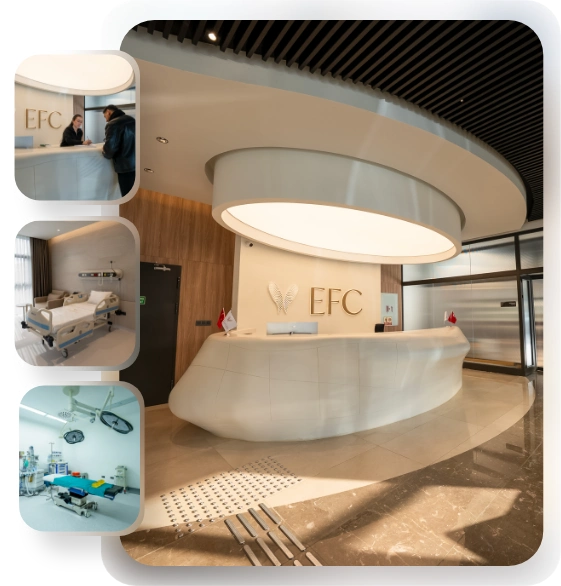
EFC CLINIC is a center of excellence specializing in the most meticulous fields of surgical medicine, from aesthetic surgery to interventional treatments—where every step progresses with refined attention. Medical excellence, aesthetic precision, and uncompromising ethical standards converge on the same path. Our subspecialty-trained experts aim to achieve natural and reliable results by delivering evidence-based care supported by modern imaging, standardized protocols, and safety systems. From consultation to recovery, your care is coordinated end-to-end with clear communication, transparent planning, and genuine respect for your health.
What is All-on-4 implant treatment and who is it suitable for?
This treatment method is virtually a lifeline for those who want to get rid of the difficulties caused by removable denture plates. Patients who have used removable dentures for years complain that these dentures become loose over time, move while eating, or dull the sense of taste because they completely cover the palate. The All-on-4 system solves these problems at the root. A fully fixed set of teeth, removable only by the dentist, is screwed onto four titanium screws placed in your jaw.
The biggest feature of this system is that it can be applied even in cases where the bone structure is weak. While traditional methods require adding bone graft material to place implants in the posterior regions, with this technique we use the existing bone in the most efficient way.
The ideal candidate profile for this treatment is as follows:
- Completely edentulous patients
- Those whose all teeth will be extracted
- Those who cannot use removable dentures
- Those with a gag reflex
- Those experiencing bone loss
- Those with time constraints
Why do we use only four implants, is this All-on-4 system safe?
The first question that usually comes to patients’ minds is, “How can 32 teeth be supported by only 4 screws?” This is where the laws of physics and biomechanics come into play. Think about how stably a table stands on four legs. If you place the legs at the correct angles and in the correct points, that table can carry tons of load. We apply a similar logic in the All-on-4 technique.
Two of the implants are placed vertically in the anterior region, where the bone is the hardest and thickest. The other two implants are positioned in the posterior region by tilting them at angles of approximately 30 to 45 degrees. This angled placement gives us the chance to use longer implants in areas where vertical bone height is insufficient. The longer the implant and the greater the surface contact with the bone, the stronger the retention. Thanks to this strategic placement, forces are distributed evenly across the jaw and the system becomes extremely safe.
Contact us now to get detailed information about our treatments and procedures and to schedule an appointment!
Can All-on-4 implants be applied in patients with bone loss?
Absolutely yes, in fact this is the very origin of this technique. In jaws that have been edentulous for a long time, serious bone loss is seen especially in the posterior regions. In the upper jaw, the sinus cavities descend, and in the lower jaw the nerve canals approach the surface. Placing a standard implant vertically here becomes impossible, and additional surgeries such as “sinus lifting” or bone grafting (bone powder) are required. These additional procedures both extend the treatment duration to 6 months up to 1 year and increase the cost.
In the All-on-4 technique, thanks to that special angulation we give to the posterior implants, we reach solid bone by passing alongside the sinus cavities and nerve canals. In other words, we “bypass” the anatomical obstacles, so to speak. Thus, without the need for an additional bone augmentation surgery, we make maximum use of your existing bone volume.
The advantages provided by this situation are as follows:
- Less surgical intervention
- Less swelling and pain
- Lower cost
- Shorter healing time
- Reduced risk of nerve damage
Are the teeth fitted immediately, will I be without teeth during the All-on-4 process?
The most appealing aspect of this treatment is that patients do not leave the clinic toothless. We call this “Immediate Loading,” meaning instant loading. On the day of the operation, if you have teeth that need to be extracted, they are extracted, your implants are placed, and impressions are taken in the same session.
There is a critical technical detail here: while placing the implant into the bone, we use special devices that measure the tightening force (torque) of the screw. If the implant tightens above a certain torque value of 35 Ncm, this indicates to us that the implant is very firmly anchored in the bone. In this case, we can fit your temporary fixed prostheses, prepared quickly in the laboratory, on the same day or within 24 hours at the latest. These temporary teeth allow you to look aesthetic and speak until your final porcelain teeth are made.
The stages you will experience throughout the process are as follows:
- Detailed tomography scan
- Digital planning
- Local anesthesia application
- Placement of the implants
- Taking impressions
- Fitting the temporary prosthesis
Is the surgical procedure painful, and how is digital All-on-4 planning done?
At the latest point technology has reached, we no longer work “by eye.” Before starting treatment, we obtain a three-dimensional jaw tomography (CBCT) from our patient. On this image, we perform a virtual surgery in a computer environment. We calculate millimetrically where each implant will be placed and at what angle. We even produce special surgical guide plates according to this plan.
During the operation, we place these guides in your mouth and open the implant sites through these guides. In this way, the margin of error drops to zero, the operation time shortens, and trauma decreases. Since the procedure is performed under local anesthesia, you do not feel any pain. After surgery, it is natural to have mild swelling or soreness, but this can be easily controlled with the painkillers we prescribe. Most of our patients can return to their normal routine the next day.
Contact us now to get detailed information about our treatments and procedures and to schedule an appointment!
What is the post-surgical recovery process like and what is the All-on-4 diet plan?
The success of the operation depends not only on the dentist’s skill but also on the patient’s compliance with post-operative rules. The fusion of the implants with the bone (osseointegration) requires a biological period. This period is generally 3 months. During this 3-month period, it is vital that the implants within the bone do not move at the micro level.
For this reason, it is essential that you follow a “soft diet” during these first 3 months while using your temporary prostheses. You must minimize chewing force and strictly avoid hard foods. Biting into an apple, eating nuts, or chewing tough meats can cause the loss of an implant that has not yet fully integrated with the bone.
The foods you can consume during this period are as follows:
- Various soups
- Mashed potatoes
- Omelet
- Yogurt
- Pudding
- Boiled vegetables
- Fish meat
- Pasta
Which materials are used in permanent All-on-4 prostheses?
After the 3-month bone healing process is completed without issues, the temporary prostheses are removed and the fabrication of the permanent teeth you will use for life begins. At this stage, materials are selected to meet your aesthetic expectations and durability needs.
Today, the materials we most commonly prefer are “Zirconium” or metal-supported porcelains. However, in the All-on-4 system, hybrid designs that also mimic the gingival portion of the prosthesis are frequently used. These prostheses are connected to the implants via intermediate components called “Multi-unit Abutments.” These components correct the angulation of the implants and ensure that the prosthesis seats passively and without tension. Passive fit is essential for the longevity of the implants.
The permanent prosthesis options are as follows:
- Monolithic zirconium
- Metal-supported porcelain
- Acrylic with a titanium bar
- Composite with a PEEK substructure
How should All-on-4 implant care and cleaning be done?
The idea of “My teeth are done, I no longer need to brush” is extremely wrong. The bacteria that decay your natural teeth cannot harm the implants, but they can infect the gum and bone around the implant. We call this “peri-implantitis,” and it is the biggest cause of implant loss.
Cleaning All-on-4 prostheses is slightly different from natural teeth. A special space is left between the prosthesis and the gum where food debris can accumulate. A toothbrush alone is not enough to clean this area. Pressurized water-spraying devices, namely oral irrigators, should be the closest friend of patients who have undergone this treatment. In addition, it is necessary to clean under the prosthesis with special dental floss called “Superfloss.” During the dentist check-ups we perform twice a year, we remove your prostheses, clean them in detail, and check the screws.
The tools required for care are as follows:
- Soft toothbrush
- Oral irrigator
- Interdental brush
- Bridge threader floss
- Mouthwash
Blog Posts

Most Preferred Countries for Hair Transplantation
Among the most preferred countries for hair transplantation are Turkey, India, South Korea, and Poland. [...]
Read More
21
Jan
Jan

Hair Transplant Prices
Hair transplant prices vary depending on the technique to be used, the number of grafts, [...]
Read More
21
Jan
Jan
Most Preferred Countries for Plastic Surgery
Among the most preferred countries for plastic surgery, Turkey, South Korea, the United States, and [...]
Read More
21
Jan
Jan

Plastic Surgery Prices
Plastic surgery prices vary depending on the type of procedure, geographical location, the surgeon’s experience, [...]
Read More
21
Jan
Jan

Physical Therapy Prices
Physical therapy prices vary depending on the number of sessions to be applied, the treatment [...]
Read More
21
Jan
Jan

Dental Treatment Prices
Dental treatment prices vary depending on the type of procedure to be performed, the quality [...]
Read More
21
Jan
Jan
Most Preferred Countries for Dental Treatments
Among the most preferred countries for dental treatments are Turkey, Hungary, Mexico, and Thailand. These [...]
Read More
21
Jan
Jan